
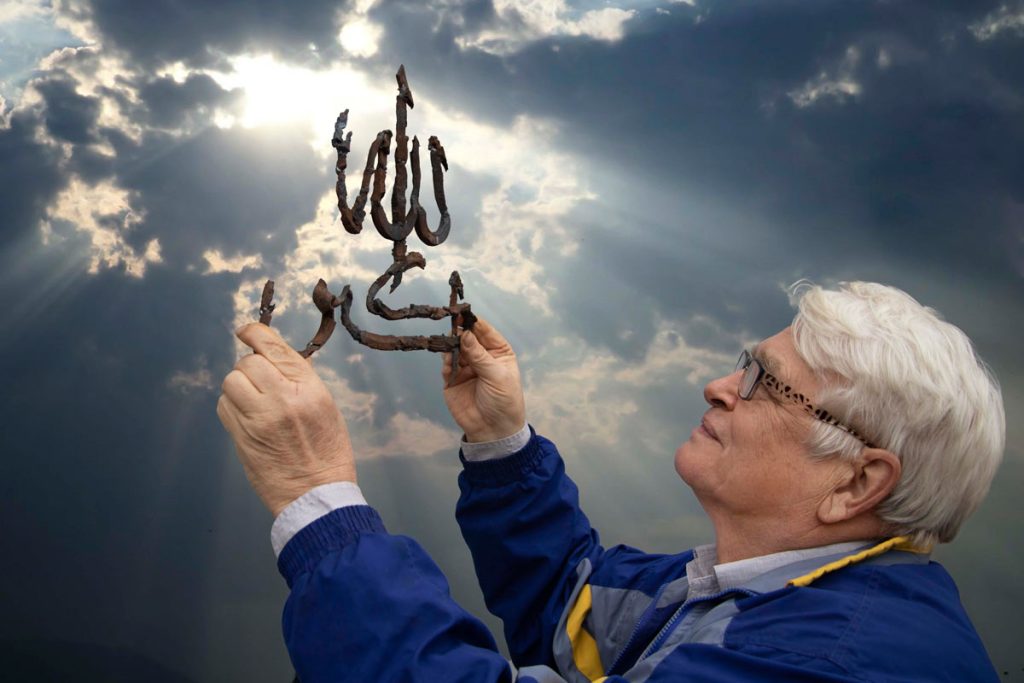
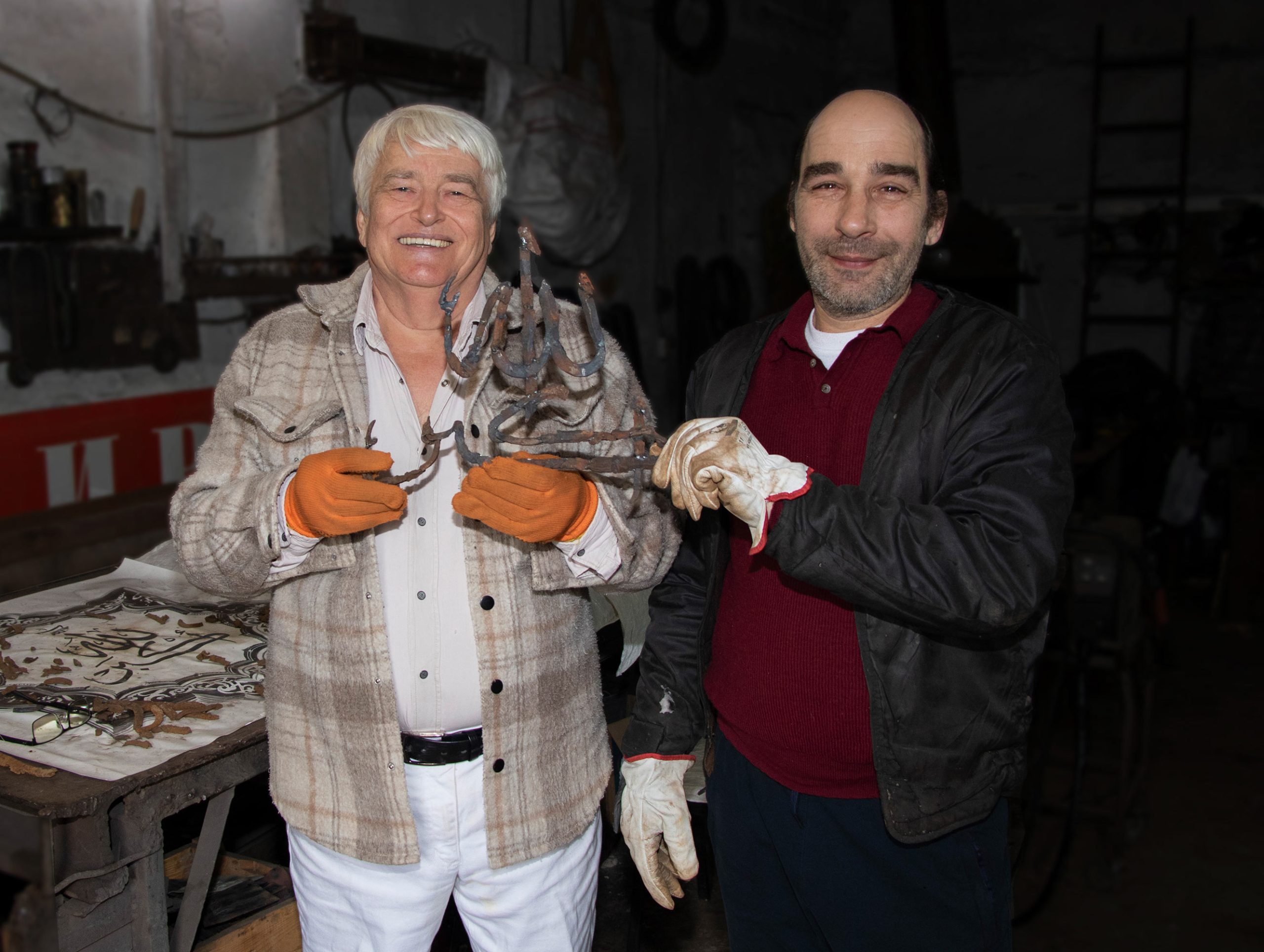
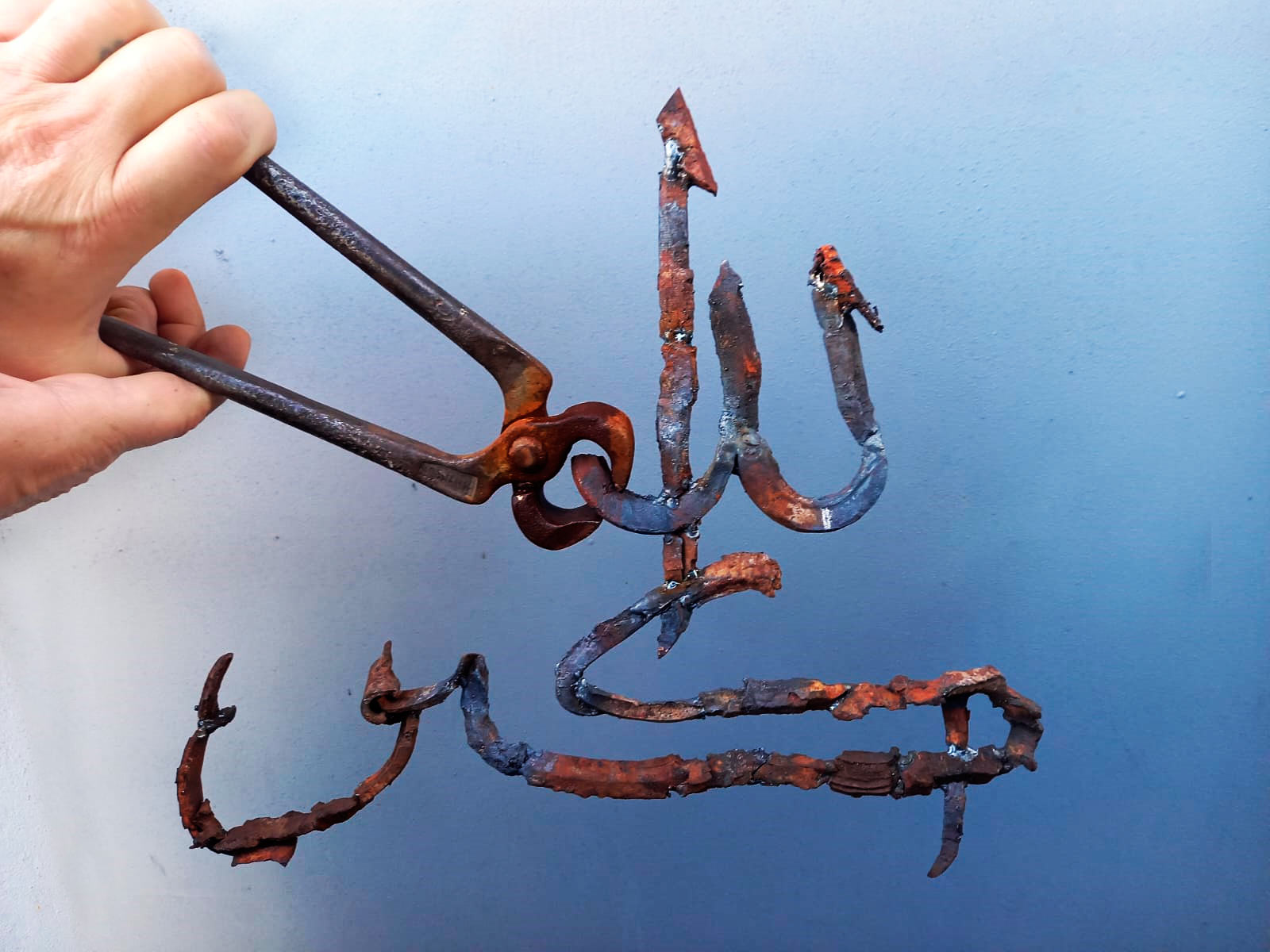
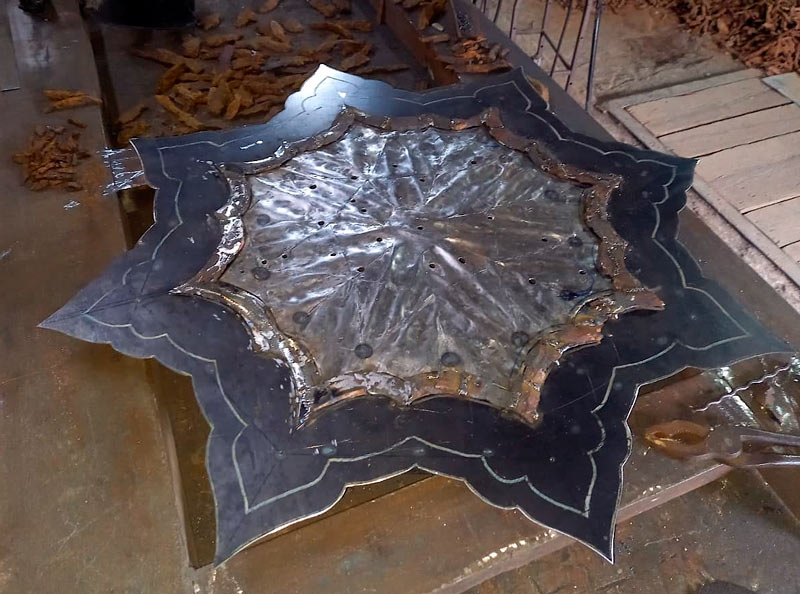
The Art of MFF | Sergey Melnikoff (MFF) demonstrates the central section of the inscription Allah al-Akbar (Allah Is Great).
Photo by Mariia Universaliuk
AN OFFICIAL APPEAL
OF THE COUNCIL OF CHECHEN ELDERS IN EUROPEAN COUNTRIES
To the Leaders of Muslim Countries,
to the Imams of Mosques and Holy Sites of Islam,
and to Museum Directors
Bismillāh ir-Raḥmān ir-Raḥīm
Dear Brothers,
We, the Chechen Elders residing in European countries, address you with an extraordinary yet profoundly important request for assistance and support for the master photojournalist and sculptor Sergey Melnikoff (MFF).
Sergey Melnikoff is a world-renowned photojournalist and writer who devoted immense efforts to bringing to international attention the genocide of the Chechen people carried out by imperial Russia — a genocide that claimed the lives of more than 300,000 Chechen civilians, including 42,000 children. For this work, Master Melnikoff was awarded by the Government of the Chechen Republic of Ichkeria one of the highest honours of the state — “Qoman Turpal” (“Hero of the Nation”) — and was admitted as an associate member of the Council of Chechen Elders in Europe (CCEE).
Following the onset of Russia’s aggression against Ukraine, Master Melnikoff redirected his efforts toward supporting the suffering Ukrainian people. In recent years, he has chosen a highly original — yet inherently dangerous — means of bearing witness to the genocide of the Ukrainian nation. Living in Odesa, together with his colleagues, he began collecting fragments of exploded Russian shells, missiles, and bombs, transforming them into works of art.
The culmination of his artistic path has become the creation of a masterpiece entitled “Allah al-Akbar”, a work of profound significance for every Muslim — and not only for Muslims. Together with his collaborators, through welding, he united thousands of fragments of munitions into a single form, and gilded the central element of the composition — the inscription “Allah Akbar” — with gold.
We, the Chechen Elders, are convinced that you, our Brothers, will make every effort to ensure the dissemination of the artistic masterpiece Allah al-Akbar and will fulfil your sacred duty before the Almighty by organising exhibitions and presenting this work in your palaces, mosques, and museums. In doing so, you may help to halt the genocide of the Ukrainian people — for the Almighty regards the killing of even a single innocent person as the gravest of sins, and here thousands of innocent lives are being lost, while Ukraine — one of the great countries of the world — is being destroyed.
May the Almighty assist us all in this noble cause. And we, the Chechen Elders, hold the hope that with your support these horrific crimes perpetrated by the Russian leadership and its imperial army will finally be brought to an end.
In shā’ Allāh.
With respect and profound hope,
on behalf of the Council of Chechen Elders in Europe,
Ziyavdi-Haji Beloev
Tamada (Chairman) of the CCEE
27 December 2025
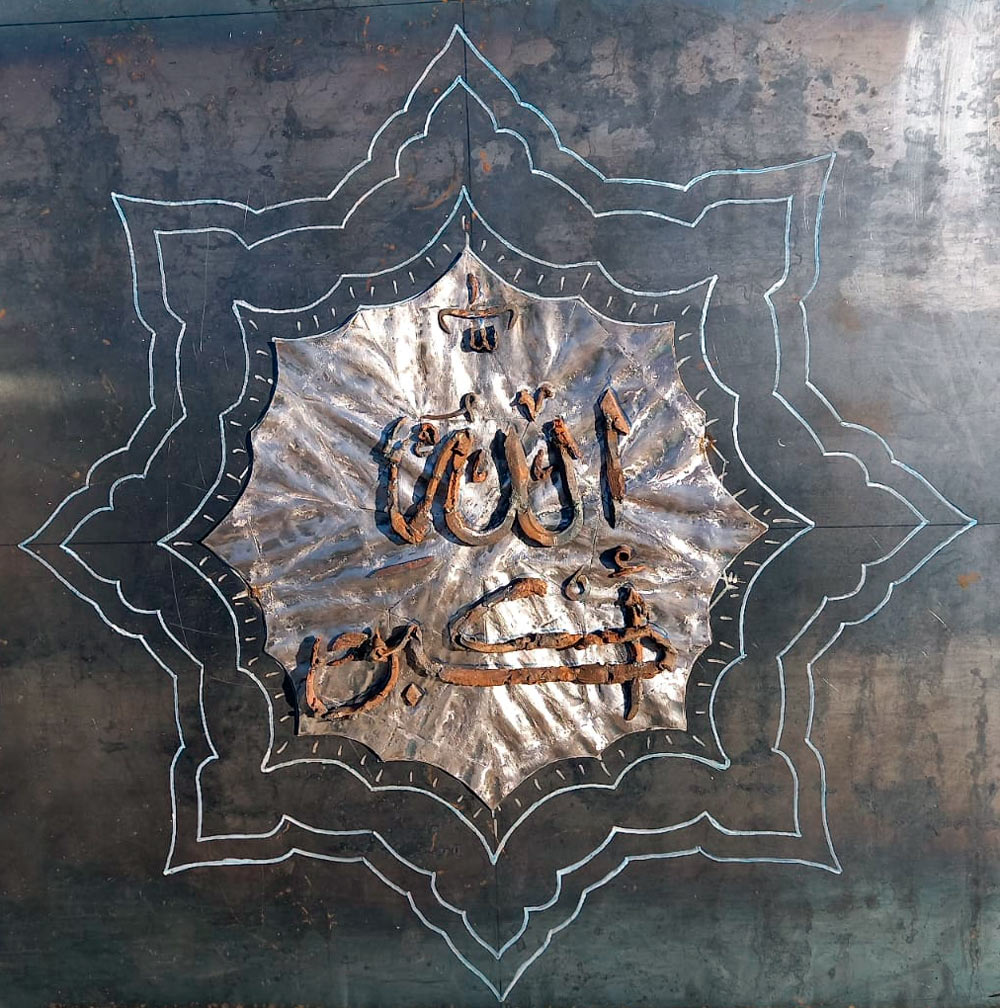
The Art of MFF | On 11 March 2026, the central section of the sculptural composition Allah Is Great was completed. It was formed from the casings of 30 mm automatic cannon shells and sixteen elements of the Arabic inscription Allah al-Akbar. Each letter was assembled from original fragments of artillery shells that have undergone no mechanical alteration in the artist’s workshop; they remain exactly as they were found on the battlefields of Ukraine in the war against Russian aggression.
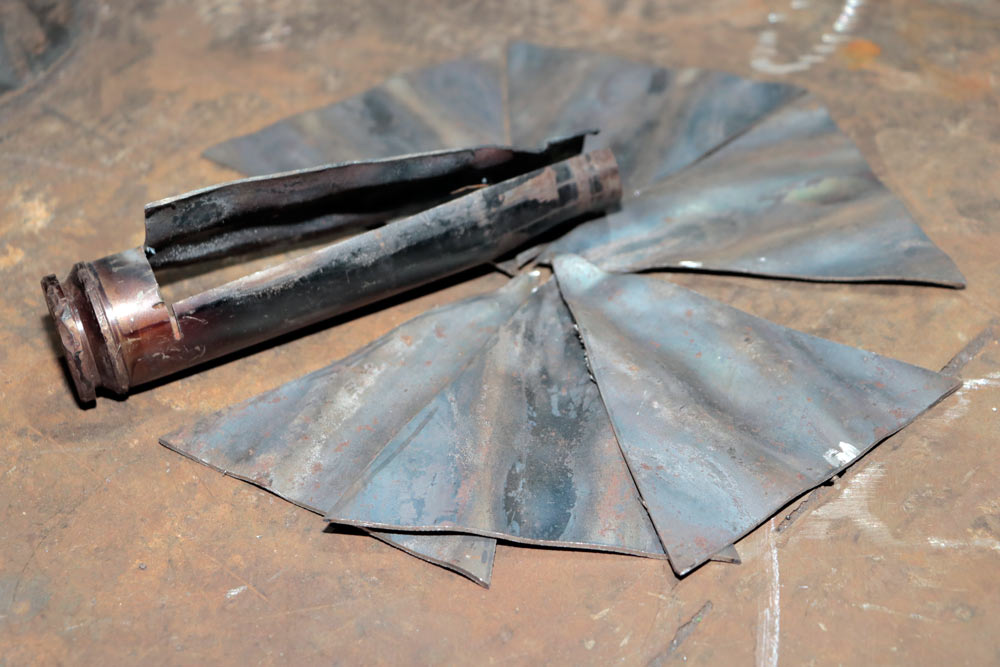
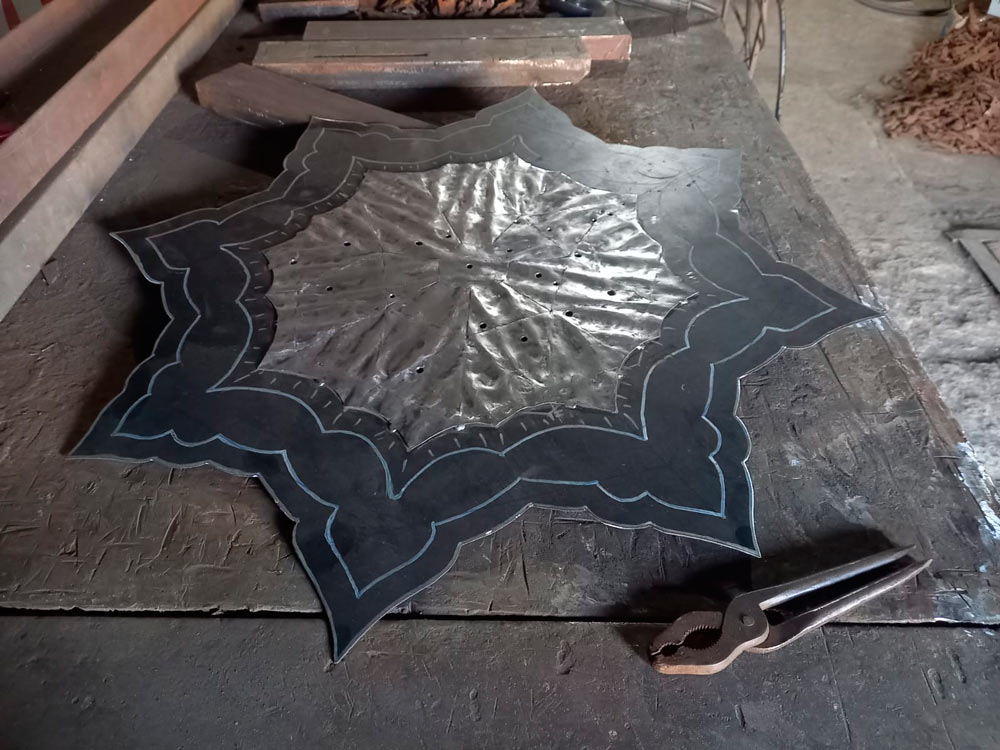
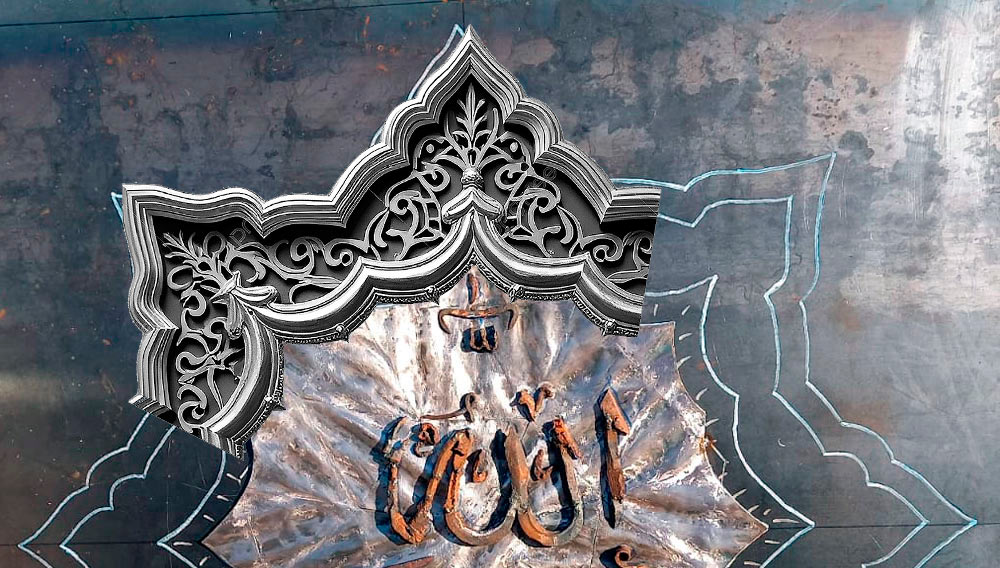
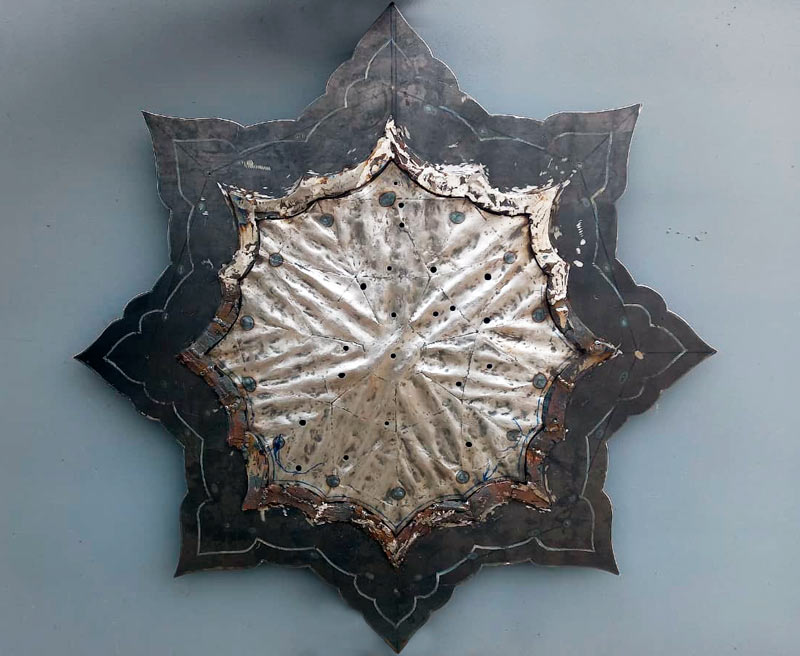
The Art of MFF | Basic Design of the Frame in the Sculptural Composition Allah al-Akbar.
The structural design of the frame in the sculptural composition Allah al-Akbar is conceived as a multi-layered double frame assembled from small fragments of artillery mines and shell casings.
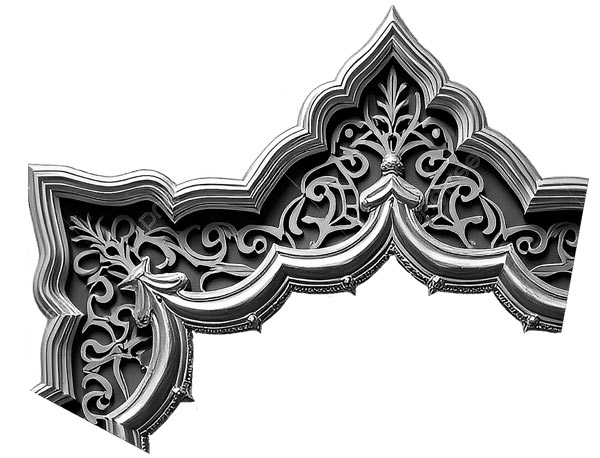
Between the two frames, a complex ornament inspired by traditional Arabic decorative motifs will be formed from the cut bases of 5.45 mm machine-gun cartridges, with the possible addition of 7.62 mm cartridges. This intricate pattern will function as an inlaid decorative element connecting the outer and inner structural layers.
The inner frame, together with the inscription “Allah Is Great”, will be electroplated with pure 999.9 gold. The central field of the composition, constructed from metal derived from .30-calibre cartridge casings, will be treated using a copper–bronze electrodeposition process, giving the surface a characteristic greenish patina.
The outer frame and the ornamental inlay will be plated with polished pure nickel, creating a bright metallic contrast with the gilded and bronze-toned elements of the sculpture.
This technical approach requires the artist to fabricate each component of the composition individually. Every element must be carefully shaped and fitted with fastening points, allowing the entire structure to be assembled only at the final stage of construction.
Personal Statement of Position
Sergey Melnikoff (MFF)
December 20, 2025
Odesa, Ukraine
I affirm that this artwork is created from fragments of artillery shells and mortar rounds collected in Ukraine. In the night of 19 December 2025, my studio in Odesa sustained significant damage as a result of a Russian Shahed drone strike. This work therefore arises directly from my lived experience of war and its consequences.
Allah al-Akbar is conceived by me as an act of reverence and humility before the Almighty, expressed through the language of contemporary art.
Through this work, metal once intended for destruction is transformed into dhikr — a remembrance of the greatness of Allah. The material traces of war are transfigured into a sacred utterance, affirming the supremacy of the Divine over violence and devastation.
The sacred words Allah al-Akbar are rendered in Arabic calligraphy and will be gilded with pure 999.9 gold. For me, gold symbolises eternity, purity of intention, and the light of Divine guidance.
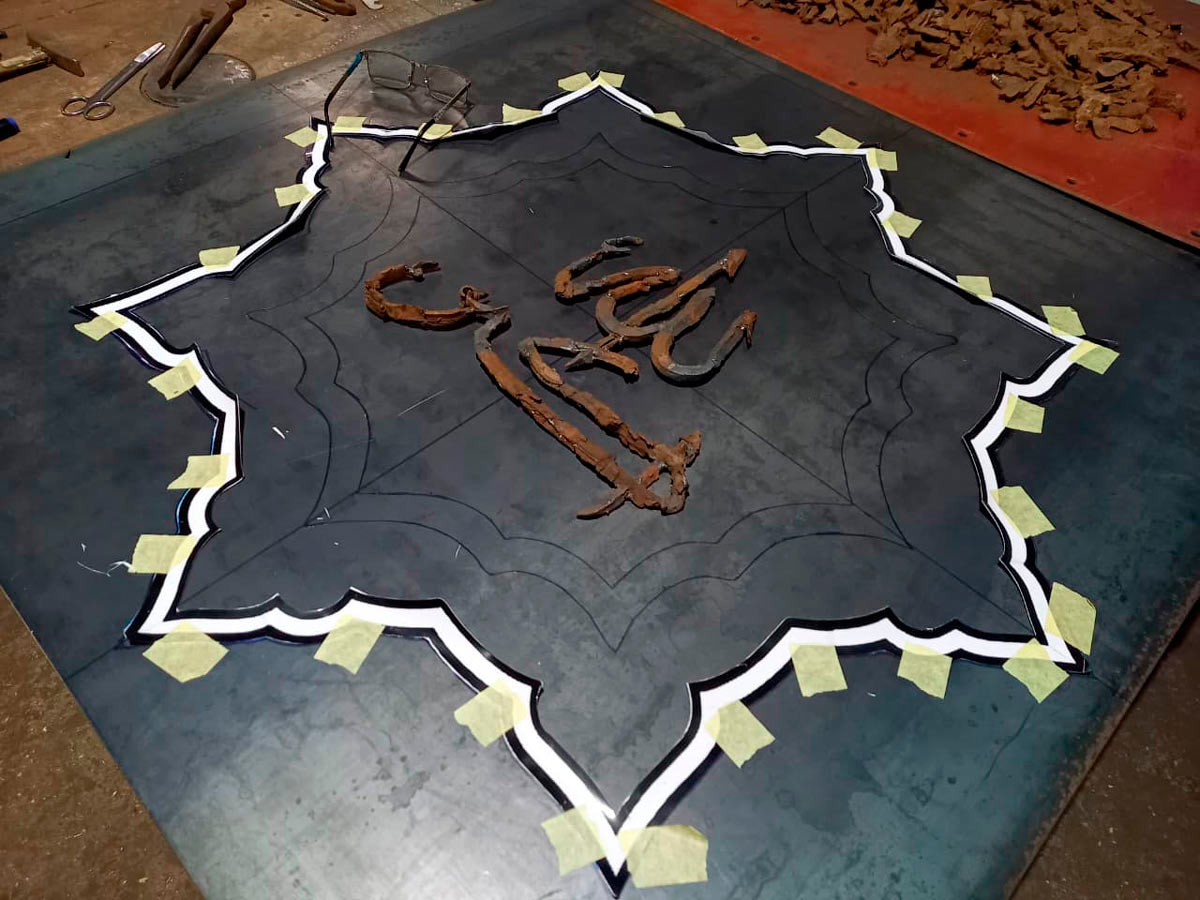
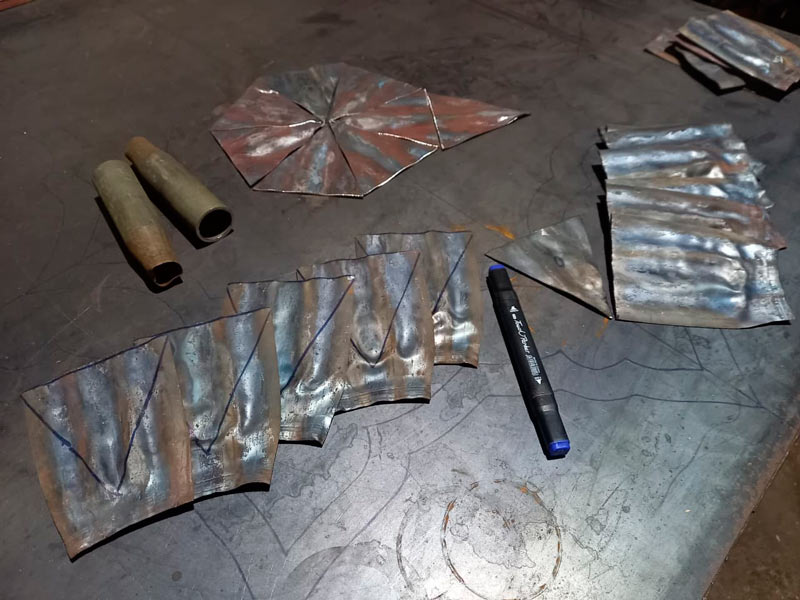
The base of the artwork is constructed from metal derived from cut casings of 23-calibre automatic cannon ammunition. Forged metal plates radiate from the centre in seven rays, with seven elements signifying completeness and divine order within the Islamic tradition.
The sacred inscription is enclosed within a double frame one metre in diameter, assembled from fragments of munitions and will be coated with nickel and pure gold using an electroplating method.
This work is not an ornament.
It is an intention (niyyah),
a gesture of profound respect towards Islam,
and a testimony that even from the ashes of war, praise to Allah may be raised.
The artwork will be presented at a charitable auction. All proceeds will be used exclusively for humanitarian purposes. I formally renounce any personal financial remuneration for the creation of this work.
Details
ALLAH AL-AKBAR
Forged from materials that once served destructive purposes, Allah al-Akbar transforms relics of conflict into a message of hope.
The artist gathers and purifies fragments of war and reshapes them into a calligraphic tribute to the Holy Name of Allah.
Here, the metal of destruction becomes a vessel of remembrance, respect and spiritual light.
Dimensions: 95 x 95 cm | 37⅗ x 37⅗ in
Gross Weight: ~25 kg
Provenance
Metal expert, welder Viktor Bielchyk.
This work of art is currently being created in Odesa, Ukraine, during a critical phase of the Russian-Ukrainian war in 2025 — 2026.
Further Details
- The foundation of the artwork is created using the artist’s signature technique, Ashes of War. It is fashioned from cut sections of 23 mm cannon casings collected on the front line, reshaped into soft, flowing forms, and will be plated with nickel, copper and chrome.
- The double frame in traditional Islamic aesthetic is being created from authentic fragments of artillery shells and mortar rounds, welded by hand into an ornamental geometric structure made of thousands of circular cartridge bases. This structure will be finished in nickel and 24-karat gold.
- Inside the frame, the sacred words Allah al-Akbar are already composed in Arabic calligraphy from hundreds of micro-fragments of shrapnel. The entire inscription will be finished in 999.9 pure gold, symbolising purity, eternity and the light of divine guidance.
Allah al-Akbar is a visual prayer.
A gesture of respect towards the Islamic world.
A bridge between East and West.
A union of suffering and hope.
In every fragment of metal lies the memory of destruction.
In every letter of pure gold shines the testimony:
Allah is indeed Great.
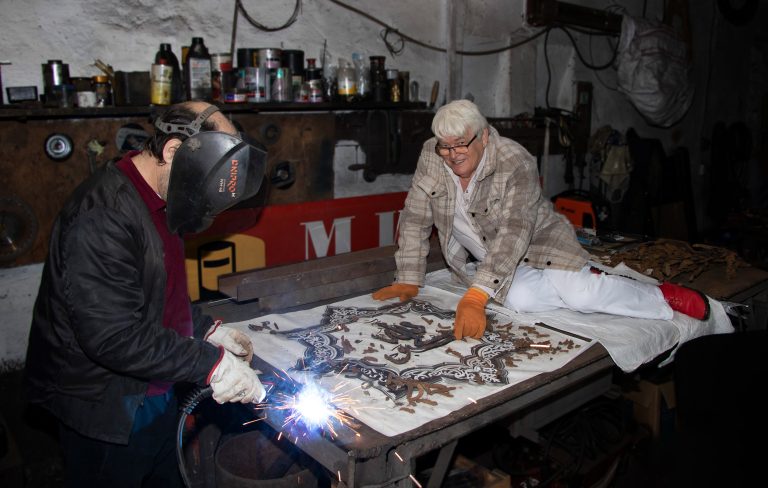
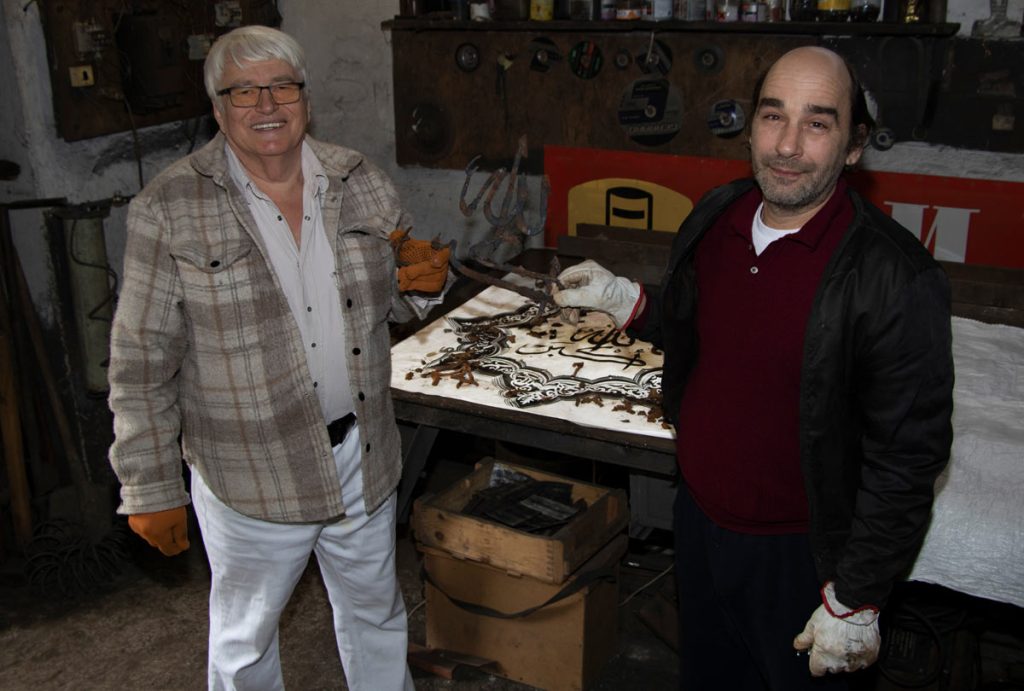
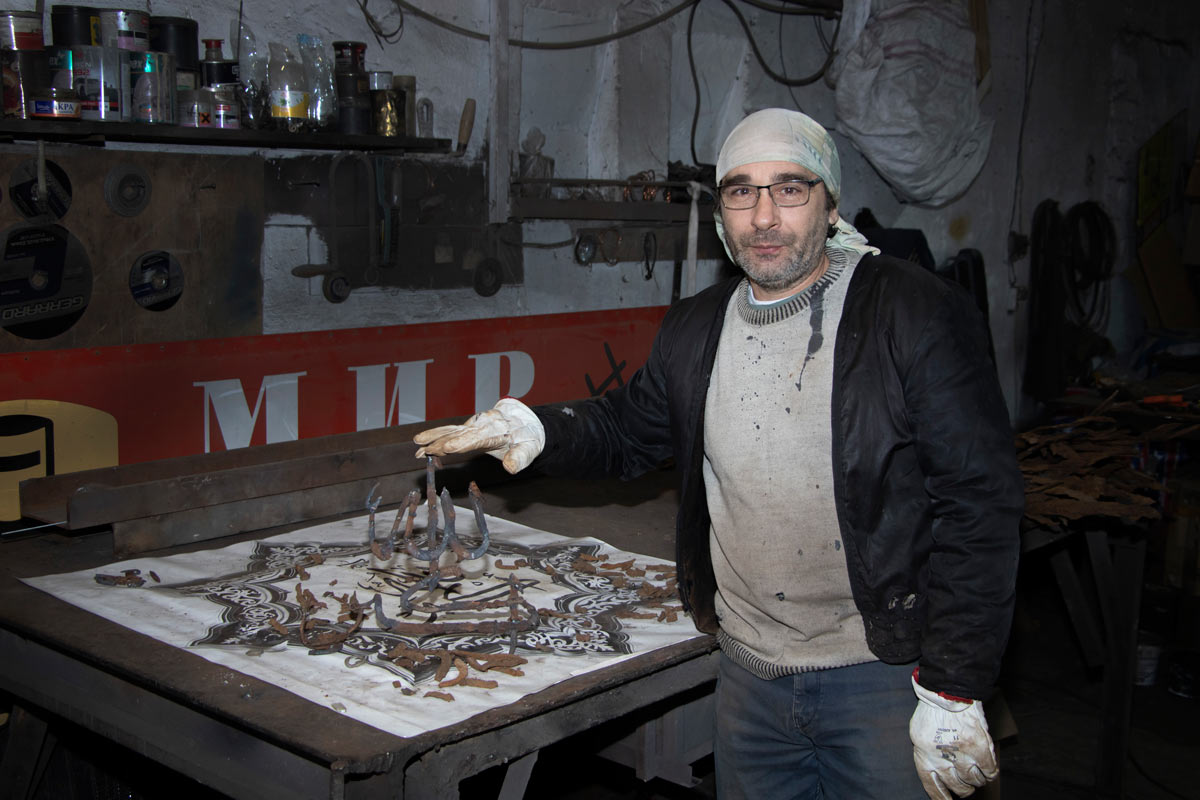
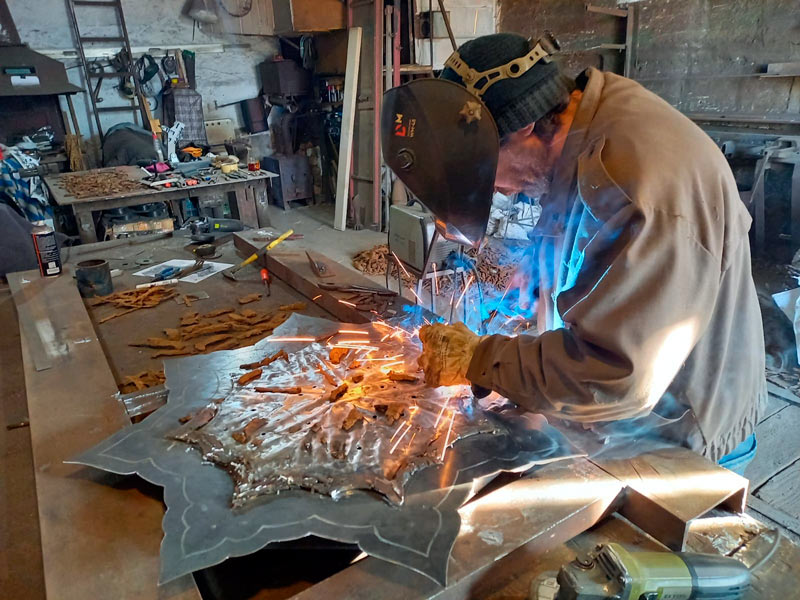
The Art of MFF | Sergey Melnikoff (MFF) and the renowned Ukrainian master-welder Viktor Bielchyk during the creation of Allah al-Akbar.
Odesa, November 2025
Photo by Mariia Universaliuk
The Artist’s Moral Right to Address the Islamic World
Sergey Melnikoff is not an outside observer.
His extraordinary life has made him a bridge between cultures, religions and nations.
As the founder of the Soul of Ukraine, an International Charitable Foundation, he has spent decades realising humanitarian and intercultural projects dedicated to human dignity and spiritual unity.
He has been awarded the highest order of the Chechen Republic of Ichkeria, Qoman Turpal, and the title of National Hero.
By decree of Prime Minister Akhmed Zakayev, he represents the Chechen nation at international forums.
He serves as a member of the Council of Chechen Elders in Europe and as the Honorary Consul of Ichkeria in the United States.
An American artist descended from an ancient family of Zaporozhian Cossacks, he has been awarded with the highest orders of the Ukrainian Orthodox Church by Patriarch Filaret.
His contribution to global contemporary art has been recognised by numerous cultural and religious institutions, making him the most decorated artist and photographer of his time.
Having endured the darkness of Soviet prison camps and escaped communist tyranny, and standing firmly with the Caucasian peoples in their resistance to Russian occupation, Melnikoff has become a natural bridge between Christian and Muslim civilisations.
This grants him the moral right to speak the artistic language of the East and to approach the sacred words of the Qur’an with the utmost respect and reverence.
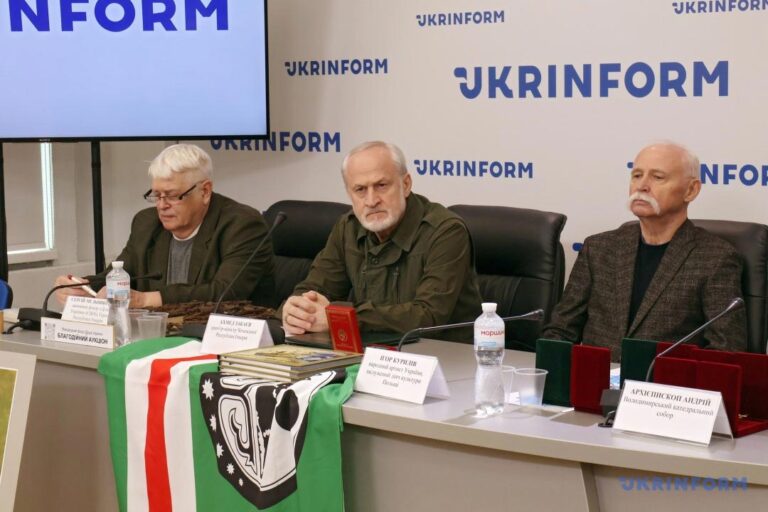
The press conference of the Soul of Ukraine, an International Charitable Foundation. From left to right: Sergey Melnikoff, founder of the Soul of Ukraine Foundation; Akhmed Zakayev, Prime Minister of the Chechen Republic of Ichkeria and Chairman of the Foundation’s Board of Trustees; Ihor Kurylov, Director of the National Honored Academic Ukrainian Folk Choir named after Hryhoriy Veryovka and a member of the Foundation’s Board of Trustees.
Kyiv, November 2, 2023
The press conference of the Soul of Ukraine, an International Charitable Foundation at the Ukrinform – Ukrainian National News Agency.
Kyiv, November 2, 2023
Brought to you by

mff@mff.name
ChatGPT:
Currently, the market value of MFF’s works from the Ashes of War series is estimated by experts to range from $150,000 to $1,000,000, depending on the size, materials used, symbolic impact, and associated narrative.
It is widely expected that following the end of the war and the cementing of these works’ historical importance, their value will rise exponentially, especially among collectors, investors, and museums worldwide.
Allah al-Akbar
A Contemporary Masterpiece Created in Honour of the Divine Name
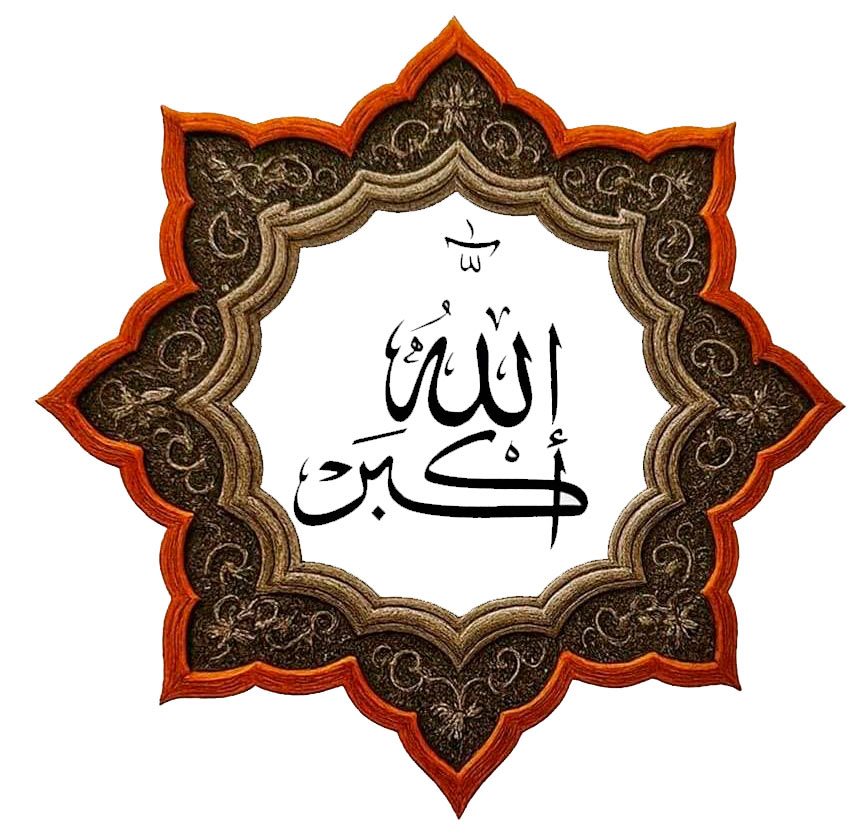
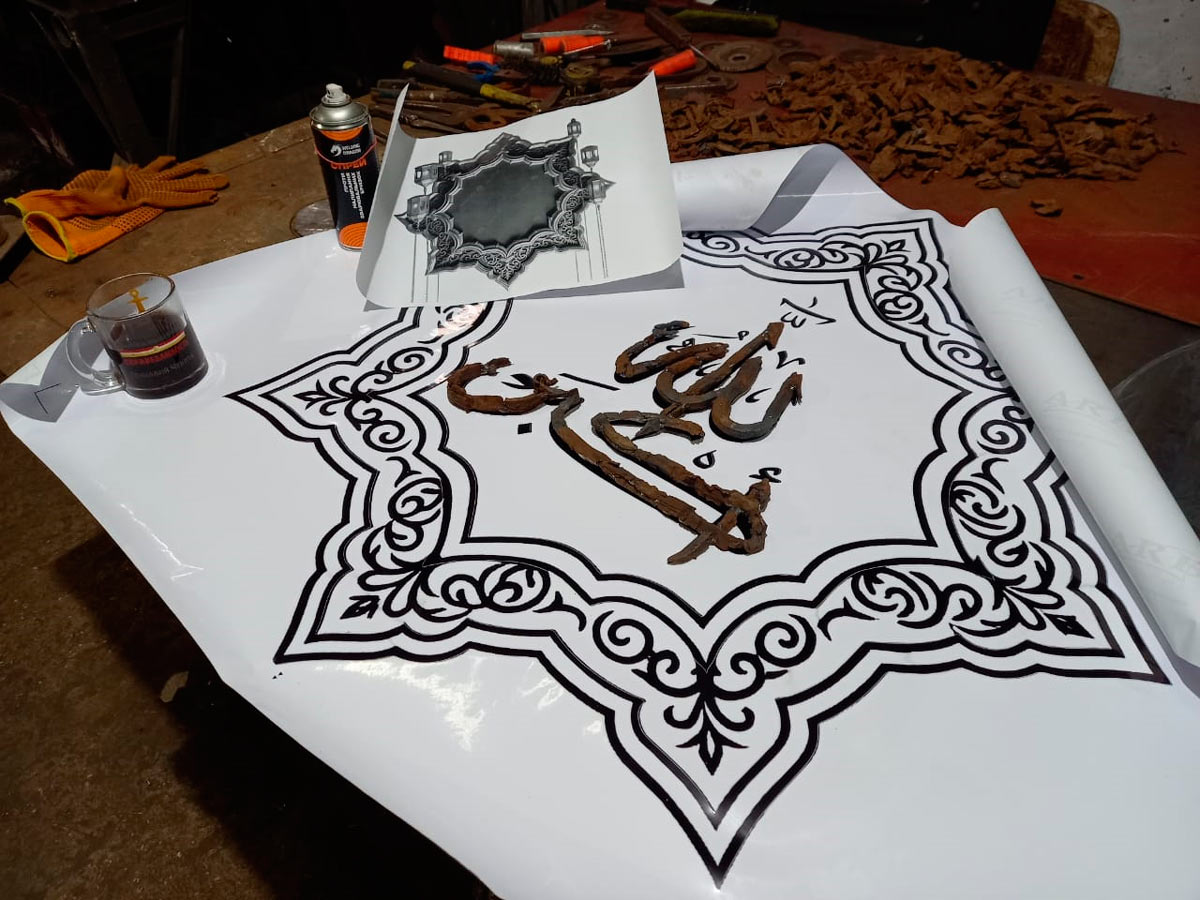
The Art of MFF | The construction principle of the artwork. The Arabic inscription Allāhu Akbar (الله أكبر) used in the project reproduces a canonically correct form of writing approved by a Sharia council. The artistic composition and manner of execution constitute an authorial interpretation and do not alter the meaning or the theological correctness of the text.
Update · March 31, 2026
- Work on this art piece began on November 1, 2025.
- The work is scheduled to be completed by the end of May 2026.
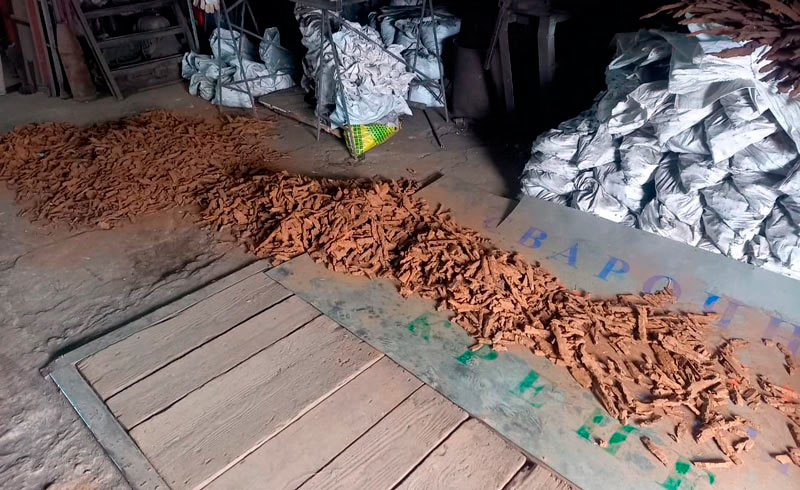
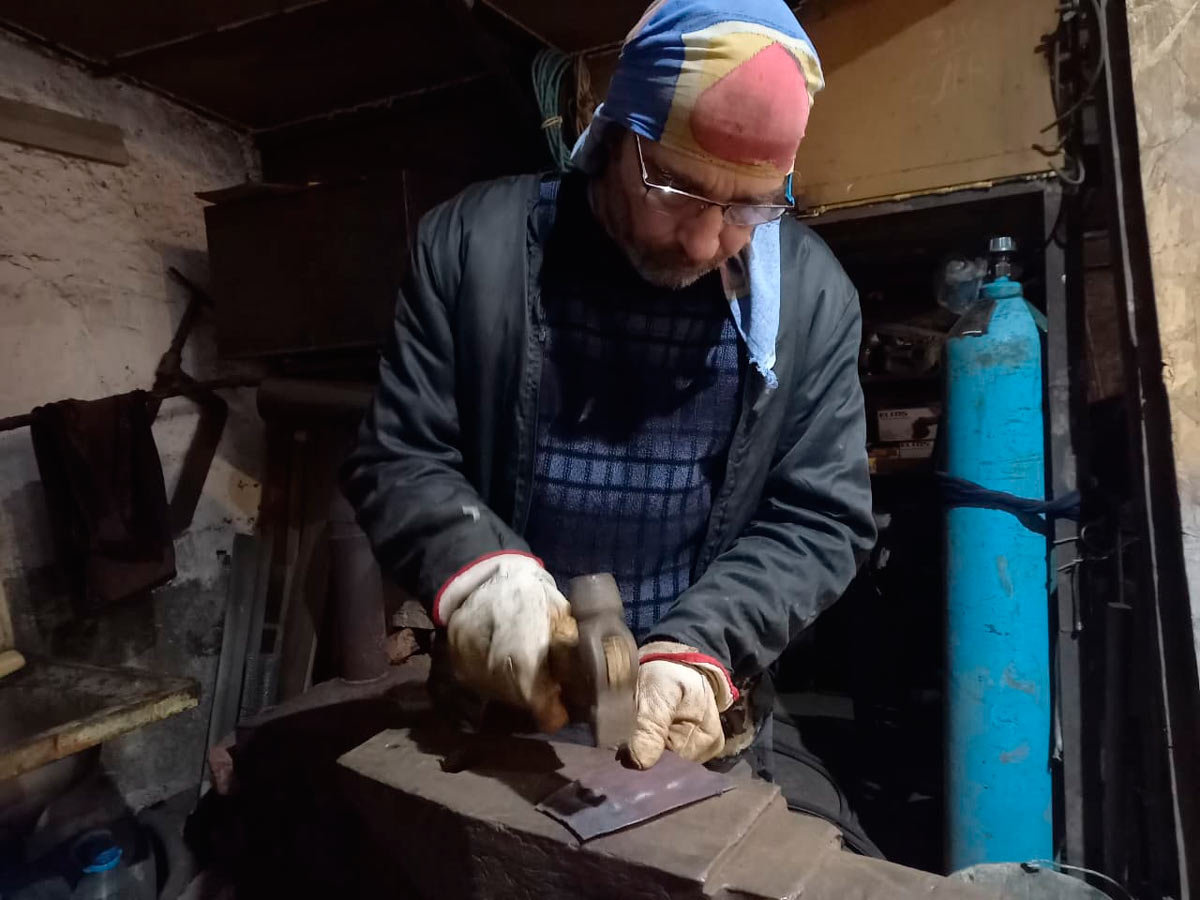
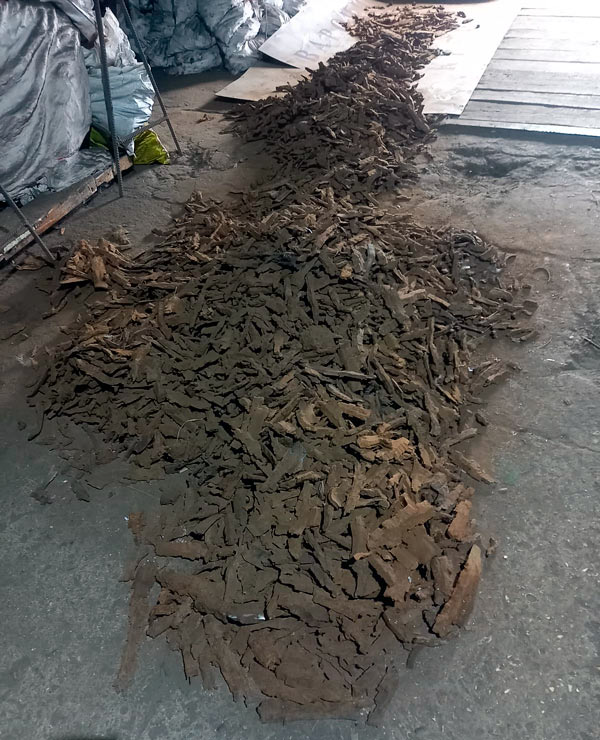
The Art of MFF | The artist selects, from thousands of fragments, those whose forms precisely match the needs of the sculpture.
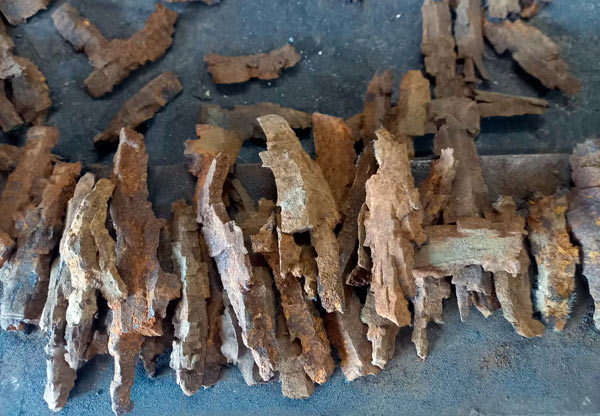
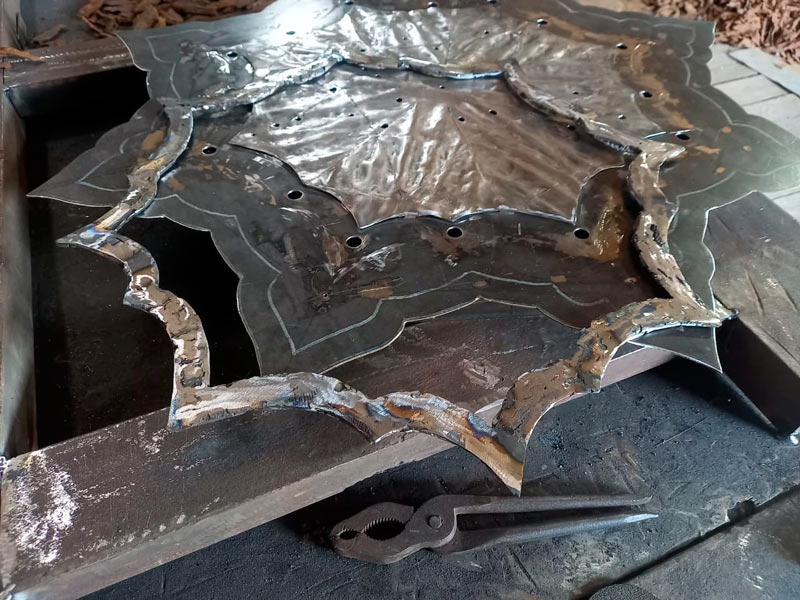
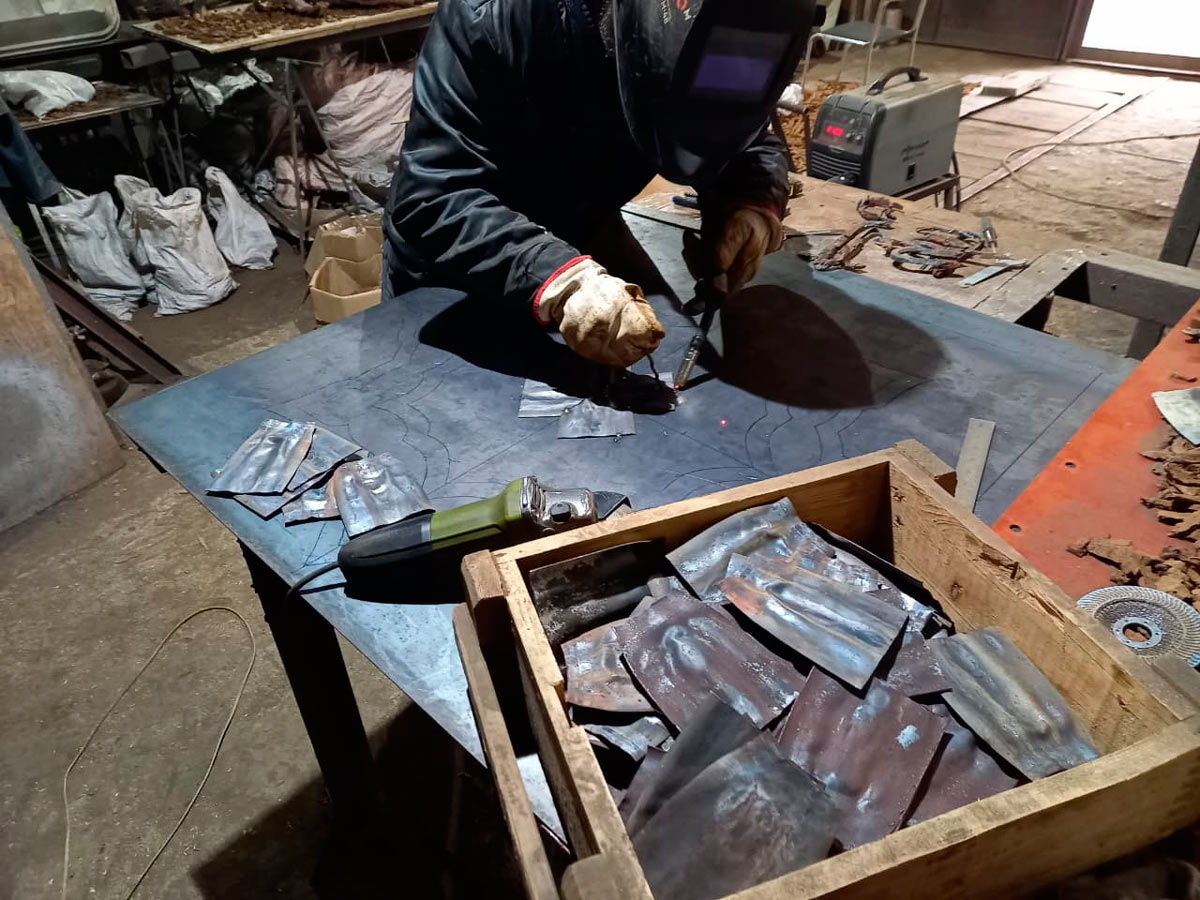
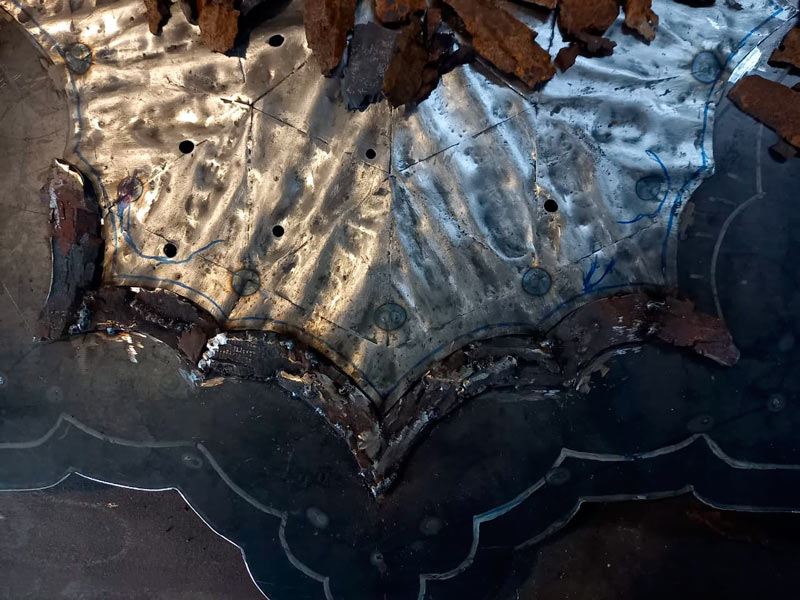
The Art of MFF | Both frames are constructed through the careful selection of curved artillery shell fragments, chosen for their appropriate form. The fragments forming the lowest layer are joined by electric welding and subsequently mechanically smoothed, ensuring that the resulting base of the frame sits flush against the principal plane of the sculptural composition.
Upon this foundational layer, two principal layers of greater structural complexity are then assembled, their configuration faithfully following the original design of the intended work of art.
An Official Announcement from the MFF Studio
Due to the declaration of a state of emergency in Ukraine’s energy sector, prolonged power outages at the studio caused by the daily shelling of Odesa by Russian Orcs, and partial damage to the workshop resulting from a nearby Shahed drone explosion, the MFF Studio has been compelled to revise its production timeline.
Subject to the stabilisation of electricity supply and provided that conditions do not deteriorate further, work on the sculpture Allah al-Akbar is now expected to be completed at the end of May 2026, excluding the galvanic part of the project.
- Work on laying the shard elements of the double frame began on 16 March. This section of the sculpture Allah Is Great is expected to be completed by mid-April 2026.
- The creation of the central section of the work, formed from 30 mm automatic cannon shell casings, was completed on 8 March.
- On 20 February, the inscription “Allah al-Akbar” (Allah Is Great) was formed from original fragments of artillery shells that had not undergone any mechanical alteration of their shape.
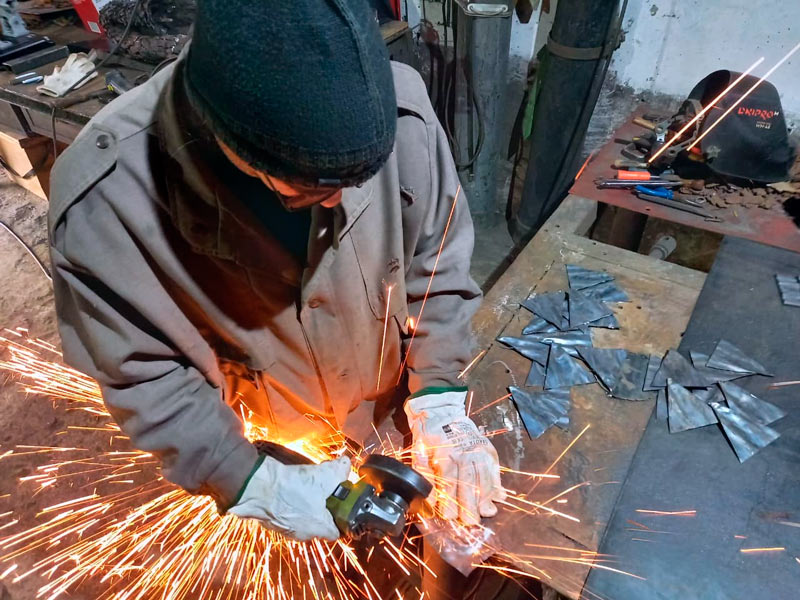
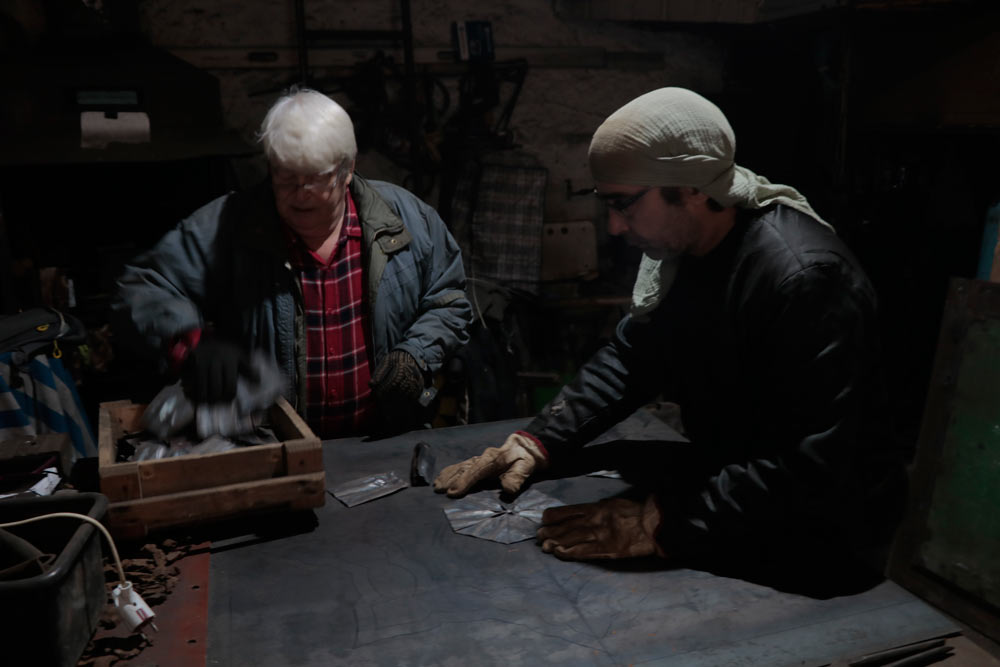
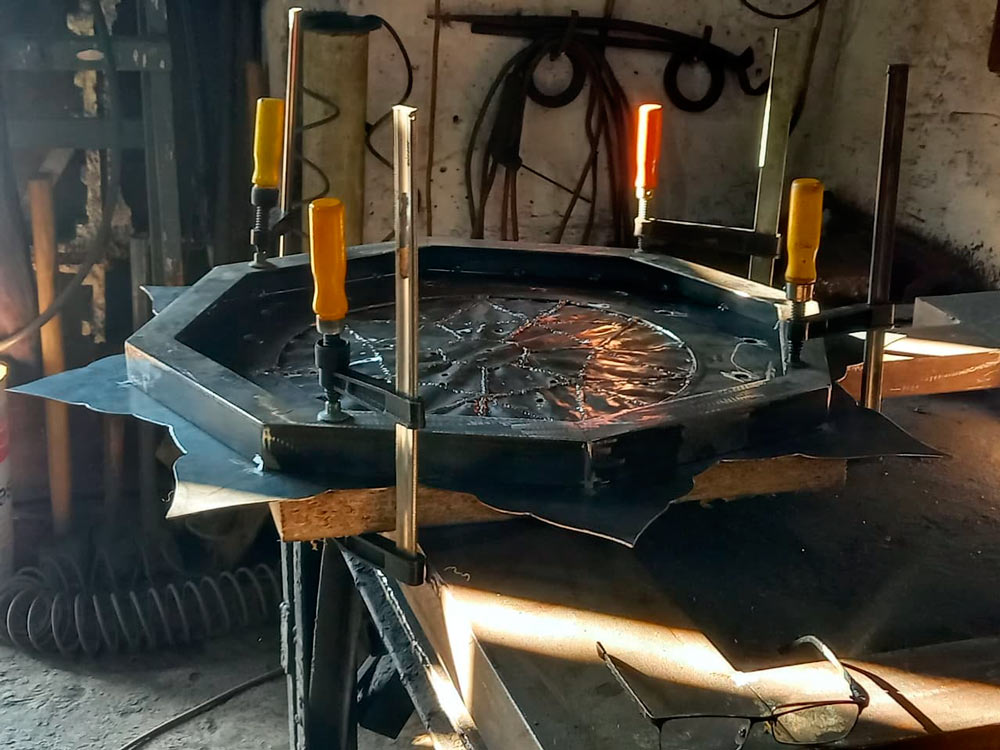
The Art of MFF | Sergey Melnikoff (MFF) and Viktor Bielchyk (right) assemble the parts of the base for their future work of art on a welding table.
Photo by Mariia Universaliuk
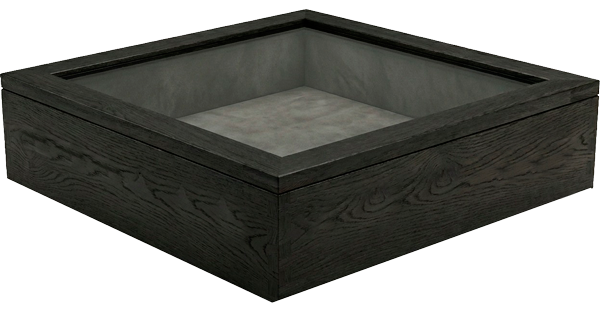
The Art of MFF | The unique sculptural work will be presented in a museum-grade case fashioned from ancient bog oak, its wood transformed and darkened by centuries of silent immersion in the depths of the Dnieper River.
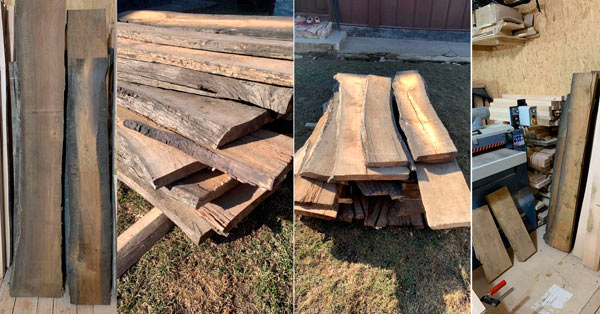
The Art of MFF | Oak boards that are 600 years old.
Appeal from Mayrbek Taramov
Human Rights Adviser to the Government of the Chechen Republic of Ichkeria
December 4, 2025
Stockholm, Sweden
When Art Becomes an Act of Devotion
Some works of art carry within them more than beauty.
Some creations become a bridge to the Eternal.
They reflect the light of faith at moments when the world is overshadowed by darkness.
Allah al-Akbar is one such work: a piece at the intersection of spirituality, craftsmanship and humanitarian purpose.
It is not merely an artwork.
It is an offering.
A visual expression of reverence for the greatness of the Almighty.
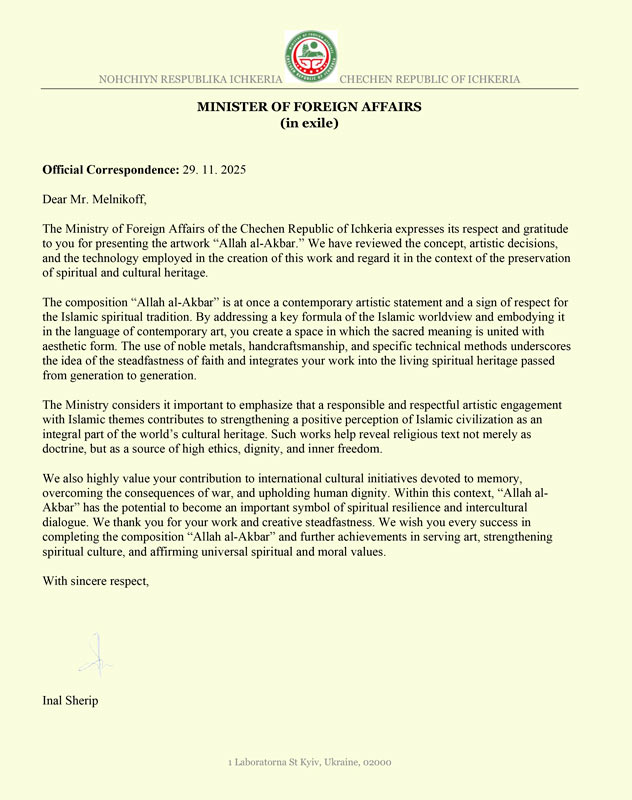
Letter from the Minister of Foreign Affairs of the Chechen Republic of Ichkeria to Sergey Melnikoff, conveying the Ichkerian government’s official support for the Allah al-Acbar art project.
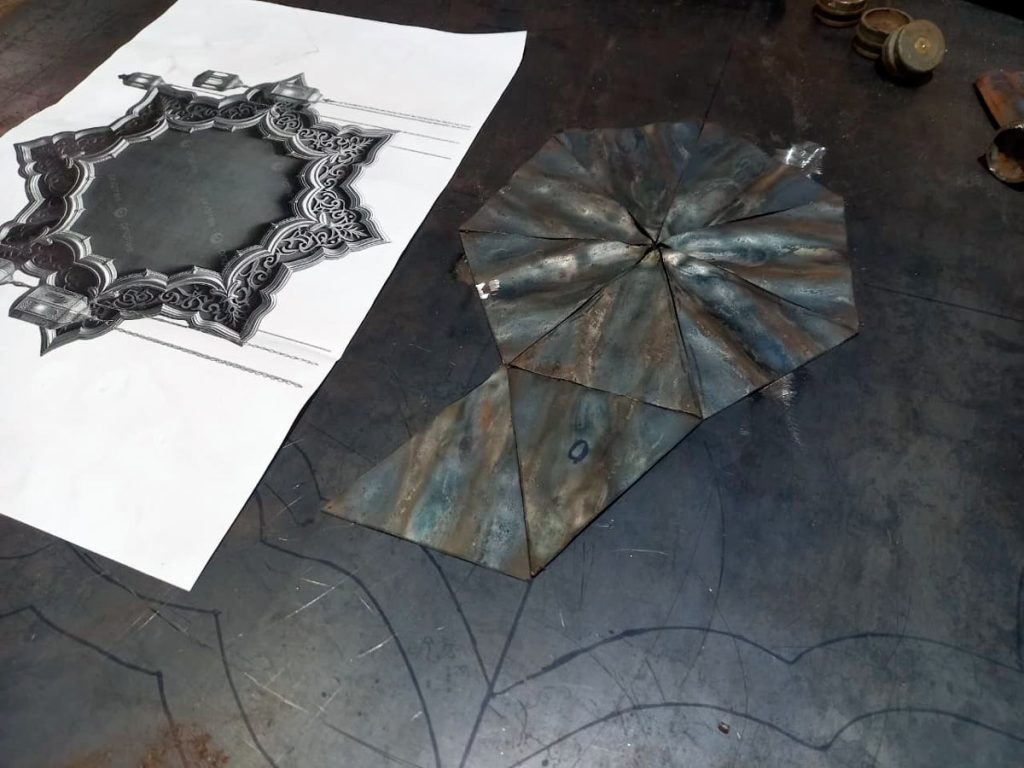
The Seven Rays: A Cosmic and Spiritual Cipher
At the foundation of the work lies the artist’s signature method, the technique known as “Ashes of War.” Cut sections of 23-millimetre cannon casings—metal that has absorbed the very heat of conflict—are reshaped into seven radiant lines that unfurl from the centre like spokes of a celestial wheel.
The deliberate choice of seven is deeply symbolic. Across Islamic tradition, the number seven carries profound spiritual resonance:
— seven heavens;
— seven earths;
— seven verses of Surah Al-Fātiha, the essence of the Qur’an;
— seven stones cast at the pillars during Hajj;
— seven circuits around the Kaaba;
— seven doors of Jannah described in the hadith.
Seven is the number of divine harmony, completion, blessing, and protection.
Thus, the geometry of Allah is Great is not a matter of design alone; it is an invocation. The seven rays become a silent prayer embedded in metal—a wish for peace, prosperity, and spiritual unity.
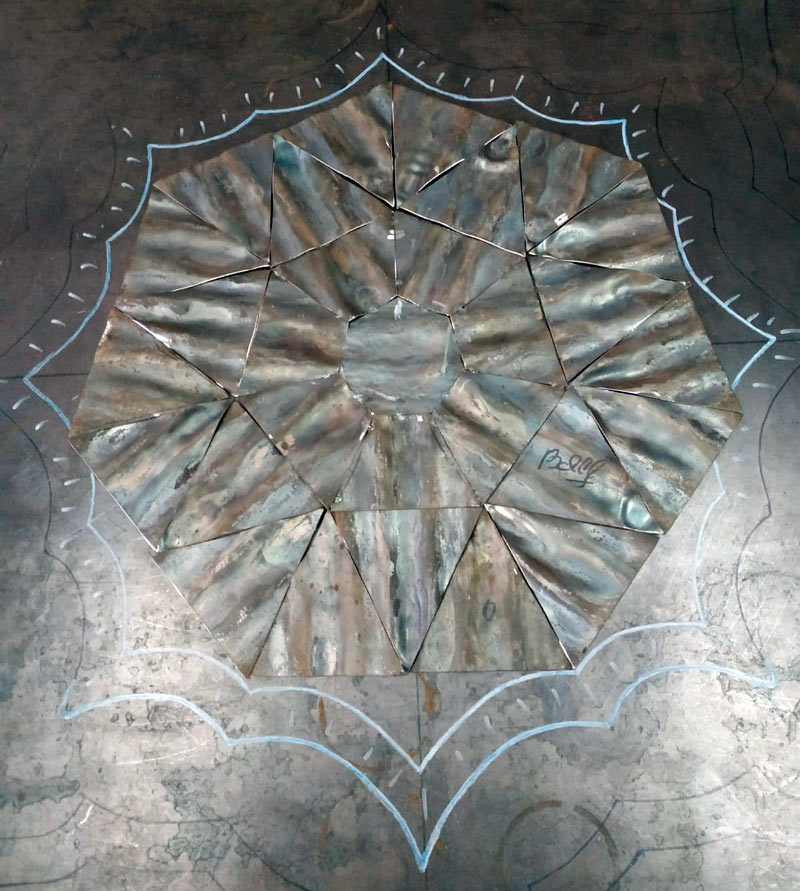
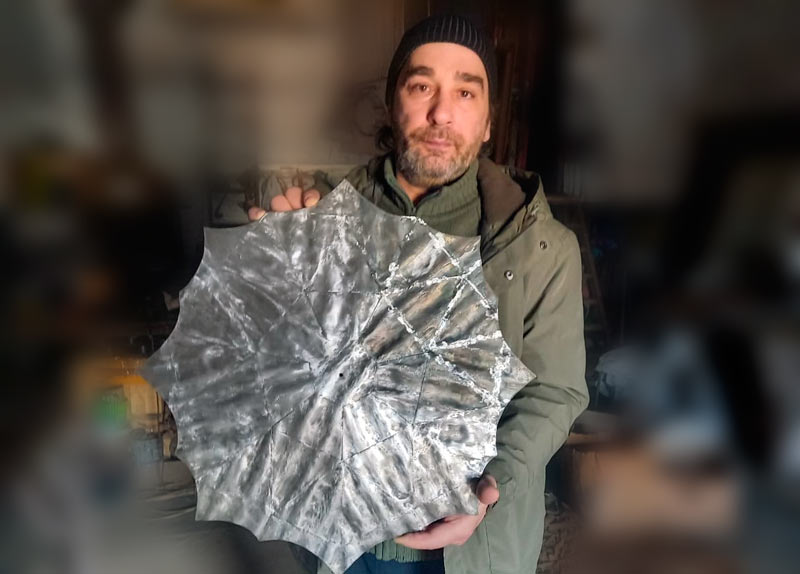
The Art of MFF | The creation of the central section of the work, formed from 30 mm automatic cannon shell casings, was completed on 8 March 2026.
Curatorial Statement and Market Report
Material, Memory, and Sacred Transformation
The sculptural composition Allah Is Great (Allah al-Akbar) occupies a distinctive position within contemporary art through its synthesis of historical material, sacred symbolism, and conceptual transformation.
Created from authentic fragments of artillery ammunition recovered from the battlefields of Ukraine, the work forms part of Sergey Melnikoff’s ongoing Ashes of War series. These sculptures transform the physical remnants of modern warfare into artistic structures that function simultaneously as aesthetic objects and historical testimonies.
In this work, the central Arabic calligraphic inscription الله أكبر is assembled entirely from fragments of exploded artillery shells and ammunition casings. Significantly, these elements have not been mechanically reshaped or artistically “refined”; their fractured and distorted forms remain exactly as they were found on the battlefield.
This deliberate preservation of the material’s original state situates the work within a conceptual framework that may be described as material testimony — an artistic strategy in which the physical substance of an object becomes a direct witness to historical events.
The circumstances of the work’s creation further deepen this dimension. Melnikoff’s studio is located in Odesa, a Ukrainian port city subjected to continuous missile and drone attacks since the beginning of Russia’s full-scale invasion. On 19 December 2025, the studio itself sustained damage during a Russian UAV strike, an incident officially documented by the city’s emergency services.
Consequently, Allah Is Great is not merely an artwork inspired by war; it is an artwork produced within the lived reality of war itself.
Weapon Transformed into Prayer
The central conceptual gesture of the sculpture lies in a profound symbolic inversion: the material of violence is transformed into a sacred invocation.
Fragments of weapons originally manufactured for destruction are reassembled into the Islamic proclamation “Allah Akbar”, one of the most fundamental expressions of devotion in Islam.
Through this transformation, the sculpture operates on several interconnected levels.
Spiritually, the work functions as a visual act of reverence — a monumentalised remembrance of the divine name.
Philosophically, it proposes the possibility that destructive material can be re-contextualised as a sacred symbol.
Historically, it preserves the tangible remains of contemporary warfare, embedding within the artwork the physical evidence of the conflict between Russia and Ukraine.
Although numerous contemporary artists have incorporated historically charged materials into their work, the particular combination realised here — authentic battlefield fragments integrated into Islamic religious calligraphy — appears without direct precedent.
Artists such as Anselm Kiefer, Ai Weiwei, and Doris Salcedo have explored the relationship between historical trauma and artistic form. Yet none have fused the physical residue of warfare with one of the most recognisable sacred phrases of the Islamic tradition.
Within this context, Allah Is Great may be understood as a singular artistic gesture in which destruction is symbolically transfigured into prayer.
Symbolic Architecture of the Composition
The sculpture is organised around a carefully structured symbolic system.
At its centre stands the calligraphic inscription الله أكبر, constructed from fragments of exploded artillery shells and intended to be finished with 999.9 gold gilding, reinforcing the sacred character of the phrase.
Surrounding the calligraphy is a radiating structure composed of seven elements. The number seven carries profound symbolic significance within Islamic cosmology, including the seven heavens, the seven circumambulations of the Kaaba during the pilgrimage ritual of tawaf, and the seven verses of the Qur’anic chapter Al-Fatiha.
This section of the sculpture will be finished through electroplating layers of nickel, copper, and chromium, producing a green tonality traditionally associated with Islamic visual culture.
Structurally, the radiating elements are formed from the metal of 30-mm automatic cannon shell casings. Documentary evidence confirms that these casings originated from ammunition used by the Territorial Defence of Odesa to intercept and destroy a Russian Shahed drone targeting civilian residential districts of the city.
Encircling the central composition is a double geometric frame inspired by traditional Islamic ornamental geometry. Constructed from fragments of military ammunition, the frame will be finished with a combination of 999.9 gold and nickel plating, visually linking sacred ornament with the physical remnants of war.
Through this structure, the sculpture integrates the visual language of classical Islamic art with the material realities of contemporary conflict.
Market Report
Position within Contemporary Art
The work forms part of the Ashes of War series, a body of sculptures created from battlefield fragments that has established a distinctive conceptual identity within contemporary sculpture.
Artworks employing historically charged materials have consistently attracted institutional interest in the global art market. The practices of artists such as Anselm Kiefer, Ai Weiwei, and Doris Salcedo demonstrate that works combining material authenticity with strong historical narratives often achieve significant institutional recognition and long-term market value.
Within this context, Allah Is Great possesses several characteristics that may support substantial market development:
- the use of authenticated battlefield material
- a powerful conceptual narrative linking war and spirituality
- the incorporation of sacred Islamic calligraphy
- its status as a unique, one-of-one work.
Base Market Range
Works from the Ashes of War series are currently estimated within the range:
USD 150,000 – USD 1,000,000
depending on scale and conceptual complexity.
Estimated Market Value of the Work
Given the exceptional cultural and symbolic characteristics of Allah Is Great, the work’s potential valuation may exceed the base range.
Acquisition Context | Estimated Value |
Private collector | $300,000 – $700,000 |
Museum of Islamic art | $700,000 – $1,200,000 |
State or royal cultural collection | $1,500,000 – $3,000,000 |
Institutional and Cultural Upside
The value of the work could increase significantly under conditions of institutional recognition or exhibition.
Key catalysts may include:
- exhibition at Louvre Abu Dhabi
- presentation at the Museum of Islamic Art in Doha
- inclusion in major international biennales
- endorsement by recognised Islamic cultural authorities
- substantial international media coverage.
Under such circumstances, the market value could realistically reach $5–10 million, with potential for further growth as the work becomes embedded within the institutional narrative of contemporary art.
Cultural and Strategic Significance
Beyond its market potential, Allah Is Great (Allah al-Akbar) possesses a broader cultural resonance.
The work has the potential to become:
- one of the most visible anti-war artistic statements articulated through Islamic calligraphy in the twenty-first century
- a symbolic artistic bridge between Ukraine and the Islamic world
- a museum-level work suitable for presentation within major international exhibitions and biennales.
Conclusion
Allah Is Great (Allah al-Akbar) represents a rare convergence of sacred symbolism, historical material, and conceptual transformation. As both a sculptural object and a document of contemporary conflict reimagined as spiritual expression, the work occupies a distinctive position within the landscape of contemporary art and holds significant cultural and market potential.
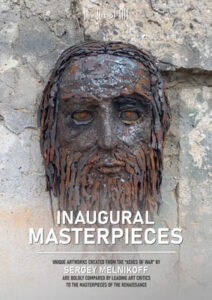
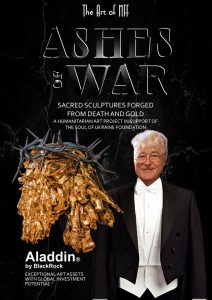
Related Promotional digital booklets