Allahu Akbar
A Contemporary Masterpiece Created in Honour of the Divine Name.
Work in Progress.
The State Information Agency GIACHECHEN PRESS has published an article by Akhmed Zakayev, Prime Minister of the Chechen Republic of Ichkeria, dedicated to artist Sergey Melnikoff (MFF) and his latest work from the Ashes of War series, Allahu Akbar.
✦ Original in Russian →
✦ Into English →
This page documents the ongoing creation of a major work from the Ashes of War series. It brings together a live production timeline, technical documentation, process photography, and supporting materials, forming a complete record of the work as it advances toward completion.
About This Page
This is not a conventional artwork presentation.
It is a live project record.
Its purpose is to preserve the chronology of the work’s creation, to document its technical evolution, and to present the materials that accompany its development under wartime conditions.
Each stage shown here reflects actual progress in the artist’s studio in Odesa.
Context
This artwork was created in Odesa, Ukraine, during an ongoing war.
The sculpture is completed in metal. The final stage is industrial electroplating.
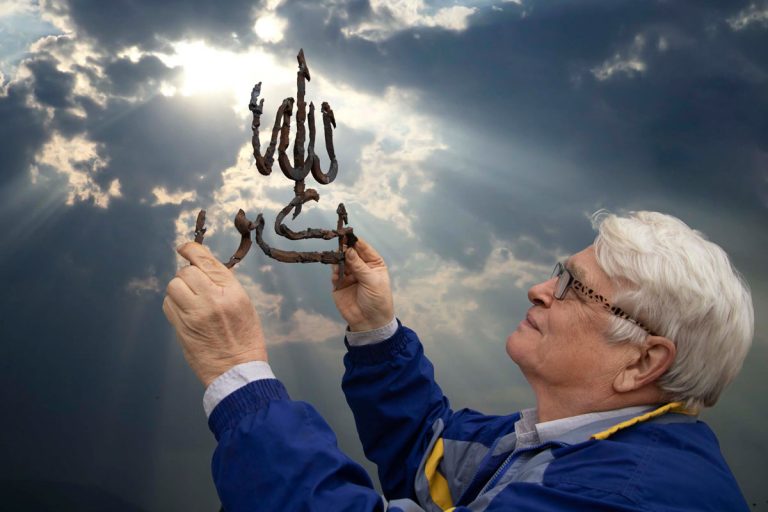
Sergey Melnikoff demonstrates the central section of the inscription “Allahu Akbar”.
When Art Becomes an Act of Devotion
Some works of art carry more than beauty.
Some become a bridge to the Eternal.
They reflect the light of faith at moments when the world is overshadowed by darkness.
Allahu Akbar is one such work — created at the intersection of spirituality, craftsmanship, and humanitarian purpose.
It is not merely an artwork.
It is an offering.
A visual expression of reverence for the greatness of the Almighty.
The Seven Rays: A Cosmic and Spiritual Cipher
At the foundation of the work lies the artist’s signature method — the Ashes of War technique. Sections of 30 mm cannon casings, metal that has absorbed the heat of conflict, are transformed into seven radiant lines extending from the centre, like the spokes of a celestial wheel.
The choice of seven is deliberate and symbolic. In Islamic tradition, the number carries profound spiritual meaning:
— the seven heavens;
— the seven earths;
— the seven verses of Surah al-Fātiha;
— the seven stones cast during Hajj;
— the seven circuits around the Kaaba;
— the seven gates of Paradise described in the hadith.
Seven is a number of harmony, completion, and divine order.
The geometry of Allahu Akbar is therefore not merely formal.
It is an invocation.
The seven rays become a silent prayer embedded in metal — a gesture towards peace, unity, and spiritual continuity.
Project at a Glance
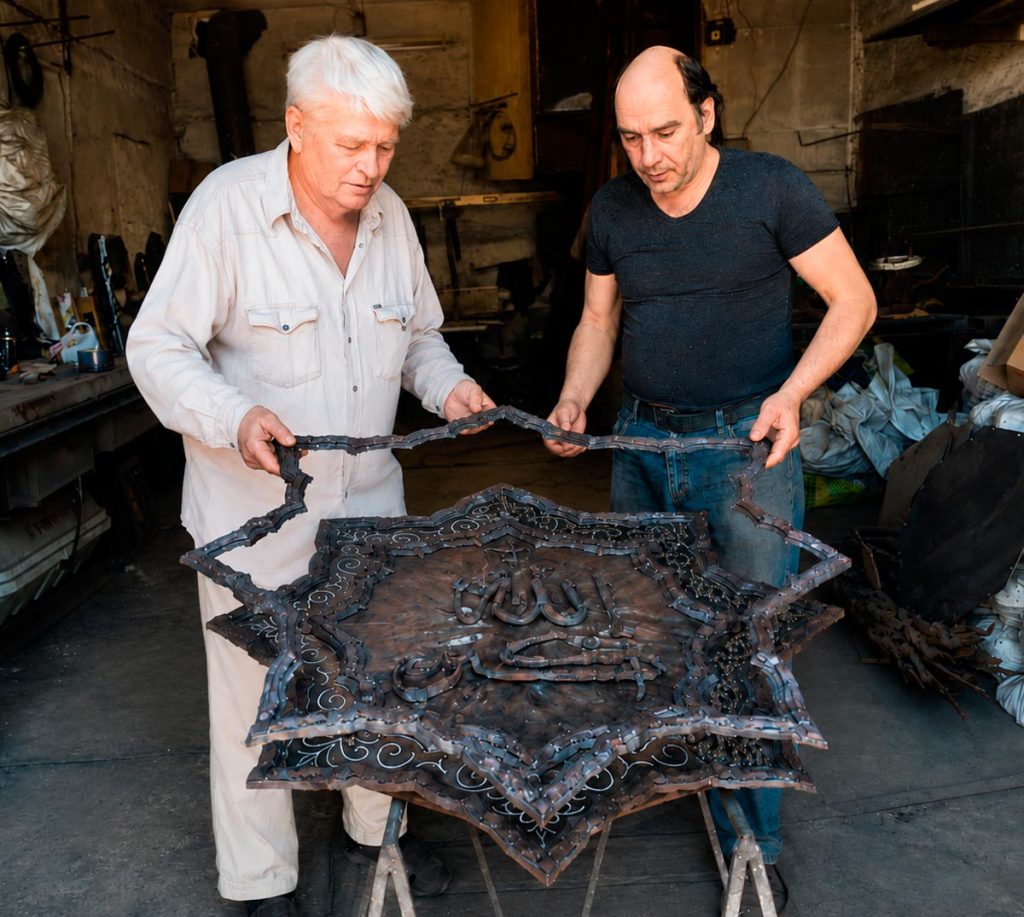
Welding and structural assembly.
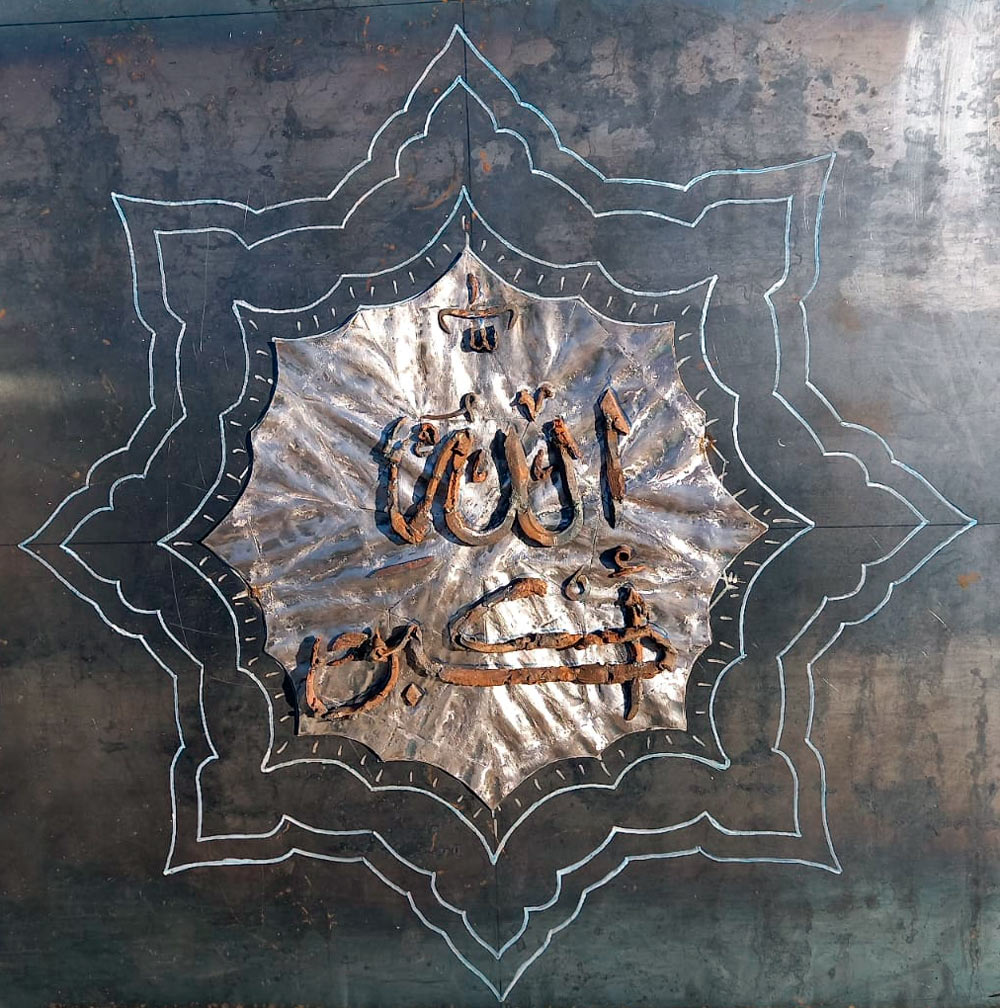
Structural assembly of the central composition. The lines of the future pattern are applied using a stencil; fragments of automatic-rifle cartridge cases will be welded along them.
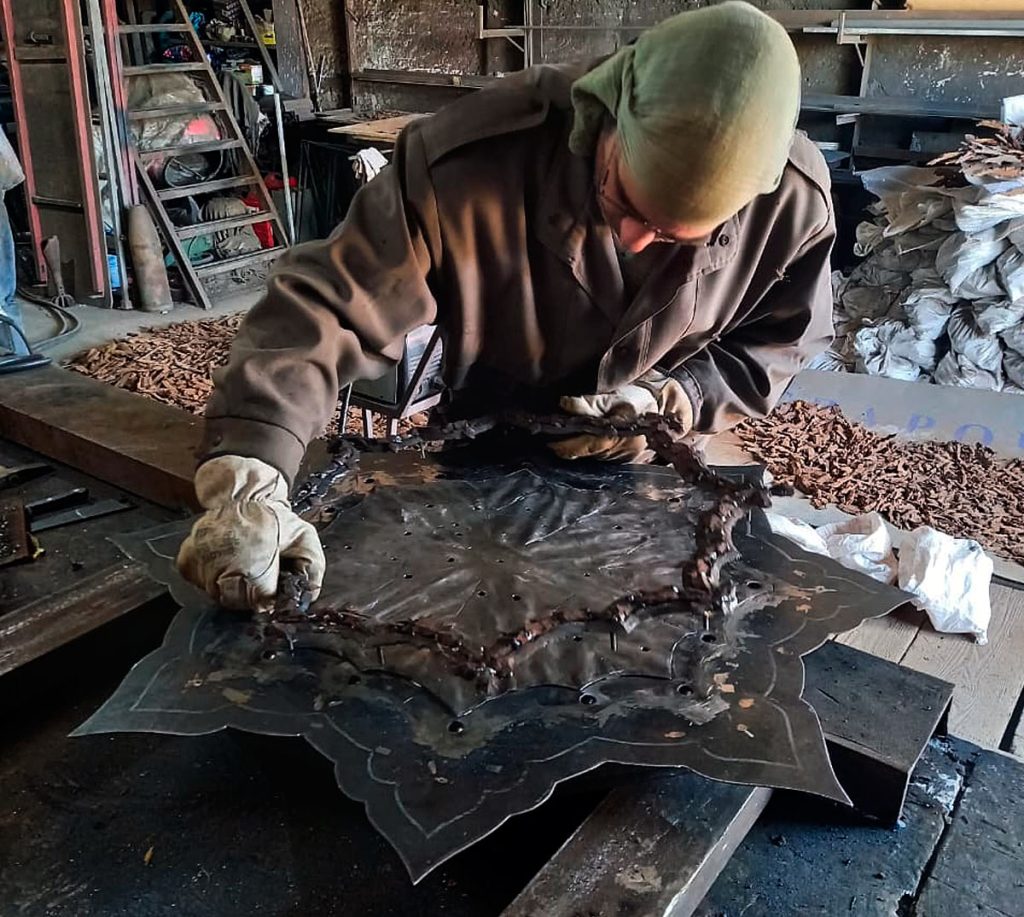
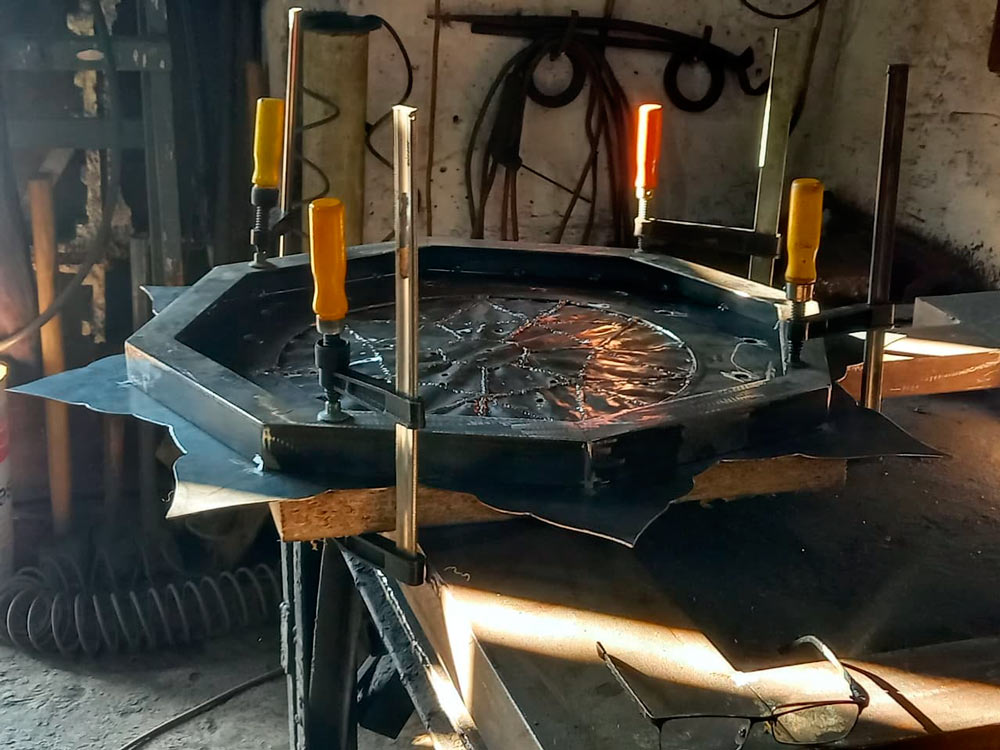
A work in production in the artist’s studio in Odesa.
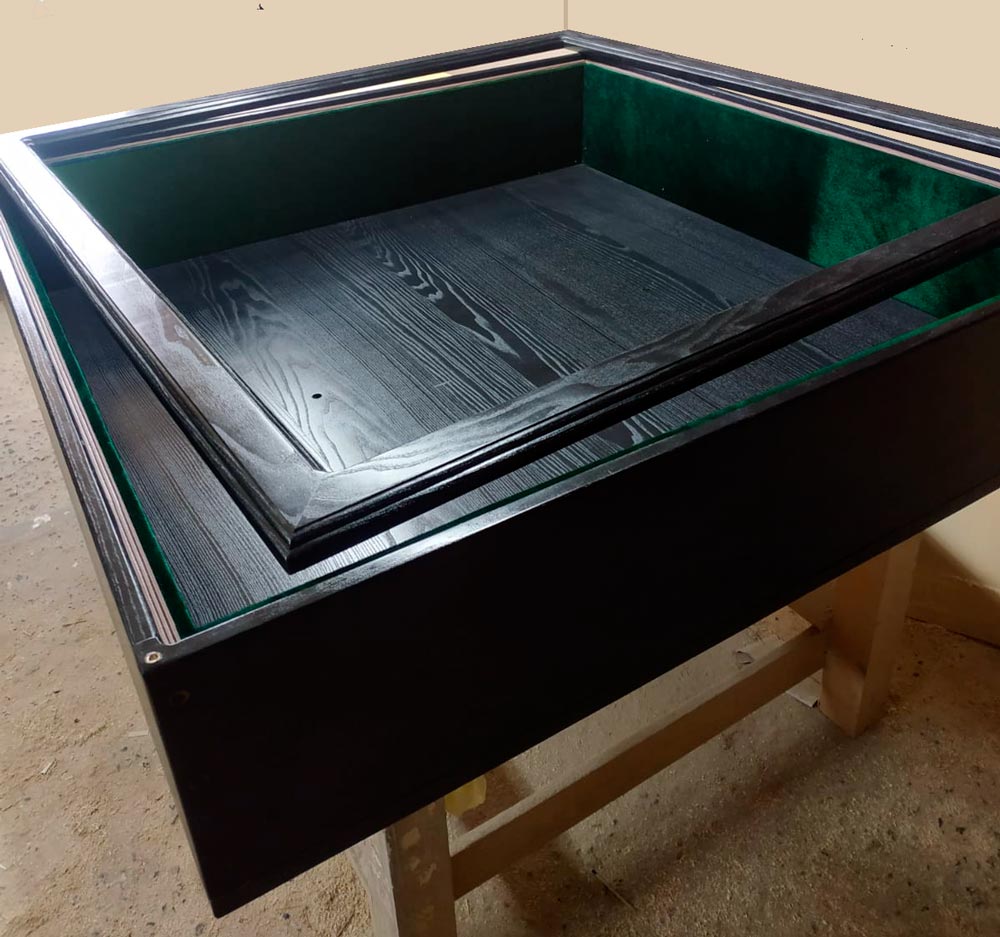
Custom museum-grade display cassette.
Context of the Artist’s Position
Sergey Melnikoff is not an outside observer.
His life has placed him at the intersection of cultures, religions, and nations.
As the founder of the Soul of Ukraine, an international charitable foundation, he has devoted decades to humanitarian and intercultural initiatives grounded in human dignity and spiritual unity.
He has been awarded the highest order of the Chechen Republic of Ichkeria, Qoman Turpal, and the title of National Hero. By decree of Prime Minister Akhmed Zakayev, he represents the Chechen nation at international forums. He serves as a member of the Council of Chechen Elders in Europe and as Honorary Consul of Ichkeria in the United States.
An American artist of Ukrainian Cossack lineage, he has received the highest distinctions of the Ukrainian Orthodox Church from Patriarch Filaret. His contribution to contemporary art has been recognised by cultural and religious institutions across different countries.
Having endured Soviet prison camps and later stood in solidarity with the peoples of the Caucasus, Melnikoff has become a bridge between Christian and Muslim civilisations.
This position allows him to engage with the artistic language of the East and to approach the sacred words of the Qur’an with respect and reverence.
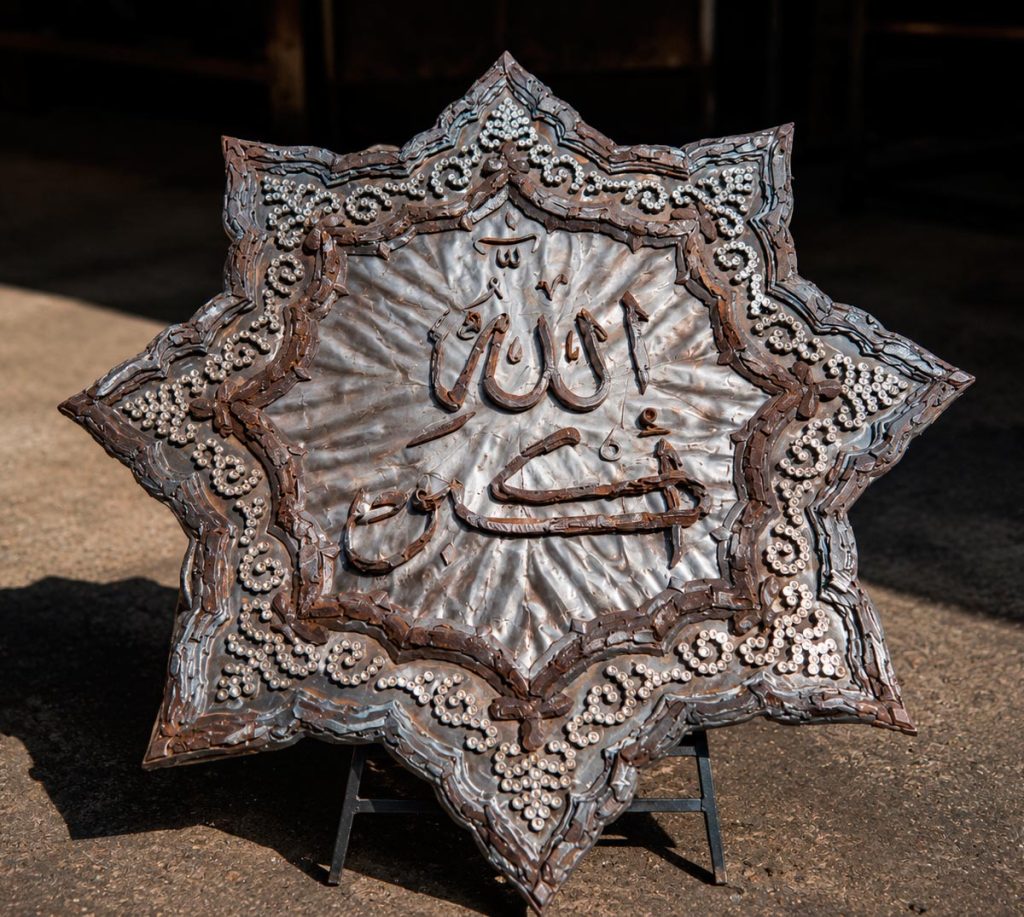
Allahu Akbar | The Construction Principle of the Artwork
Overall Diameter: 950 mm
Materials: Constructed from authentic 23 mm ammunition casings, fragments of artillery shells and mortar rounds, and 5.45 mm cartridge cases. Finished with nickel plating and 999.9 fine gold.
Idea & Design by Sergey Melnikoff • MFF
Welding work by Victor Bielchyk
Odesa, Ukraine, 2025-2026
The Arabic inscription “Allāhu Akbar” (الله أكبر) used in this work follows a canonically correct form of writing approved by a Sharia council. The artistic composition and method of execution constitute an authorial interpretation and do not affect the meaning or theological integrity of the text.
Project Overview
Work on Allahu Akbar commenced on 3 October 2025.
The metalwork phase was completed on 15 June 2026, excluding galvanic finishing. Thus, the project took 255 working days to complete.
AYAT AL-KURSI — QUR’AN 2:255
Ayat al-Kursi, the Throne Verse, is the 255th verse of Surah Al-Baqarah and one of the most revered passages of the Holy Qur’an.
LATEST UPDATE — END OF SEPTEMBER 2026
[✔] Concept Development
[✔] Calligraphic Inscription
[✔] Central Part
[✔] Inner Frame
[✔] External Frame
[✔] Back Cover
[✔] Ornament
[✔] Cleaning & Finishing
[✔] Packaging & Transportation for Galvanizing
[➤] Electroplating (current)
[ ] Final Completion
[✔] Custom Museum-Grade Display Cassette
[✔] Transport Crate
- An additional US$78,000 is required to complete the galvanic finishing process.
- To learn more about the Allahu Akbar art project, please download the information brochure in PDF format here →
Artwork Documentation Portfolio
[✔] Certificate of Authenticity
[✔] Certificate of Origin
[✔] Certificate of Ownership
[✔] Provenance Record
[✔] Technical Specification
[✔] Radiological Safety Certificate
[✔] Toxicological Safety Certificate
[✔] Certificate of Materials and Conservation Treatment
[✔] Artist Statement
[✔] Photographic Documentation
[ ] Condition Report
[ ] Phytocontrol Certificate for Wooden Packaging
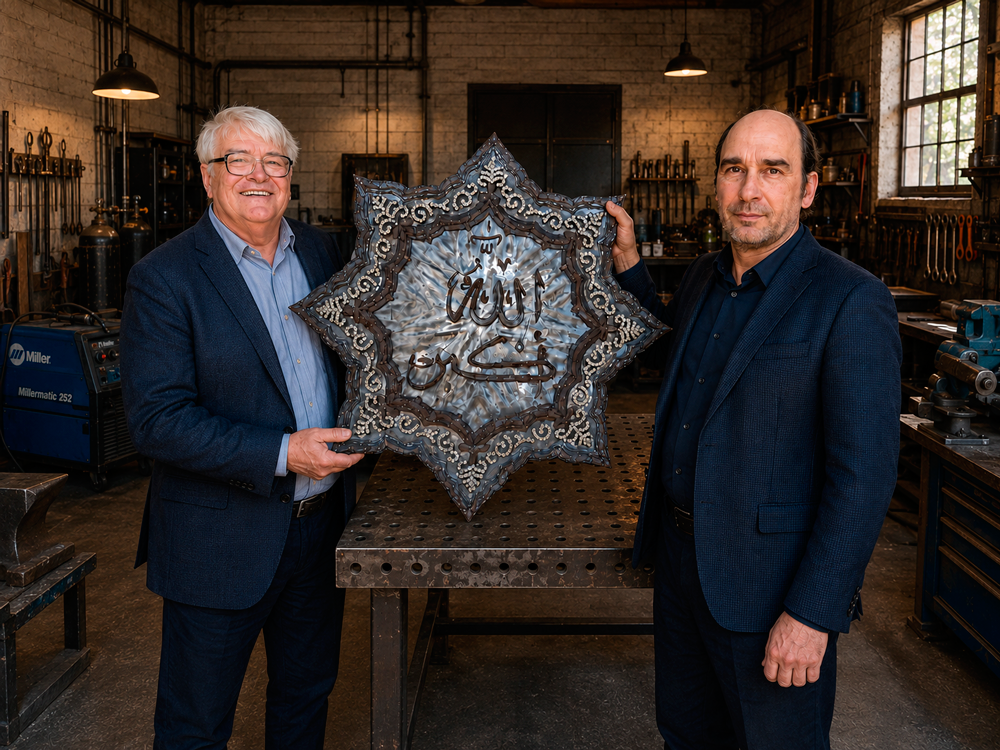
Sergey Melnikoff (MFF) and Ukrainian metal craftsman Viktor Bielchyk present the completed artwork “Allahu Akbar” prior to its final multi-stage electroplating in nickel and 999.9 fine gold.
Odesa, 15 June 2026.
One of hundreds of individually machined 5.45 mm cartridge casings prepared for the ornamental framework of “Allahu Akbar”. The shaping of every element is required to conceal weld joints and allow the curved geometry of the composition to be assembled by hand.
The decorative elements between the two frames are formed from fragments of 5.45 mm calibre cartridges, of which more than 700 are required.
Technical Specifications
Medium
Mixed metal (artillery fragments)
Technique
Ashes of War
Materials
Original battlefield fragments
Dimensions
95 × 95 × 20 cm (37½ × 37½ × 7⅞ in)
Estimated weight
~20 kg
Planned finish
Gold (999.9) and nickel electroplating
Production costs
US$200,000, including electroplating of the artwork with 999.9 gold.
Purpose
Charitable sale
Provenance:
Held by The Soul of Ukraine Foundation, Inc. since its creation.
SUPPORTING DOCUMENT
Personal Statement of Position
Sergey Melnikoff (MFF)
20 December 2025
Odesa, Ukraine
Statement (excerpt)
I affirm that this artwork is created from fragments of artillery shells and mortar rounds collected in Ukraine. On the night of 19 December 2025, the artist’s studio in Odesa sustained significant damage as a result of a Russian Shahed drone strike.
Official document (PDF)
INSTITUTIONAL TESTIMONIES
The Council of Chechen Elders
in European Countries
Ziyavdi-Haji Beloev
Chairman (Tamada), CCEE
27 December 2025
An Official Appeal (excerpt)
We, the Chechen Elders residing in European countries, address you with an important request for assistance and support for the master photojournalist and sculptor Sergey Melnikoff (MFF).
Official document (PDF)
INSTITUTIONAL TESTIMONIES
Ministry of Foreign Affairs
Chechen Republic of Ichkeria
Inal Sharip
Minister of Foreign Affairs, CRI
19 November 2025
London, Great Britain
Official Correspondence (excerpt)
The Ministry of Foreign Affairs of the Chechen Republic of Ichkeria expresses its respect and gratitude for the presentation of the artwork Allahu Akbar.
Official document (PDF)
INSTITUTIONAL TESTIMONIES
Cabinet of Ministers
Chechen Republic of Ichkeria
Mayrbek Taramov
Human Rights Adviser,
Government of the CRI
4 December 2025
Stockholm, Sweden
Statement of Support (excerpt)
On behalf of the Human Rights Adviser to the Government of the Chechen Republic of Ichkeria, I express sincere support for the creation of the proclamation Allahu Akbar.
Official document (PDF)
The gallery is updated as “Allahu Akbar” progresses