
The Final Bridge
On an Artist, Loyalty, and Spiritual Dignity in Time of War
By Akhmed Zakayev
Prime Minister of the Chechen Republic of Ichkeria
In the history of every nation, there are individuals who do not belong to it by blood, language, or birth, yet become part of it in spirit. For the Chechen people, this carries a particular meaning. Ours is a nation that knows all too well the value of words spoken in difficult times—and the value of silence, behind which fear, indifference, or political calculation so often hide.
Sergey Melnikoff was not born a Chechen. He did not grow up among us. He was under no obligation to share our pain, our history, or our struggle. Yet during one of the darkest chapters in the history of the Chechen people, he stood among the few who did not turn away. He spoke when many preferred silence. He saw in the Chechen tragedy neither a convenient political narrative nor a distant regional conflict, but a question of human dignity.
That is something the Chechen people never forget.
In our tradition, a person is judged not by the volume of his words, but by his loyalty in times of trial; not by his origins, but by his character; not by his promises, but by his deeds. The respect that Chechens hold for Sergey Melnikoff is therefore neither accidental nor fleeting. It rests upon the memory that, during one of the most difficult periods of our history, he stood on the side of truth. Such remembrance cannot be purchased, manufactured, or bestowed by decree. It is earned where courage reveals itself in action.
Today, as war once again devastates Ukraine, history appears to be repeating one of its harshest lessons. What Chechens endured in Grozny, Argun, Samashki and countless other towns and villages, Ukrainians have witnessed in Mariupol, Bakhmut, Kharkiv, Odesa and innumerable other places. Different countries, different eras, different circumstances—yet the same imperial logic of violence. Destroy the city. Break the will. Erase the memory. Force a people to surrender its dignity.
For this reason, the connection between the Chechen and Ukrainian tragedies is not merely political; it is moral. We understand Ukraine’s suffering not through newspaper headlines or official briefings. We recognise in it our own experience. We know what it means to live under bombardment. We know what it means to watch the world search for convenient language while people are dying. We know what it means to defend not only territory, but a nation’s right to remain itself.
Against this backdrop, Sergey Melnikoff’s work Allahu Akbar acquires a significance that extends far beyond the realm of art. Its importance lies not only in its artistic merit. More important still is the fact that the artist has turned to a theme rooted in the deepest foundations of the human spirit. He has taken the metal of war—a material created for destruction, death and fear—and transformed it into a sacred symbol of memory and spiritual witness.
Within that transformation lies a profound moral meaning.
War always seeks to deprive human beings of their inner foundation. It destroys homes, but more dangerously, it attempts to destroy the soul. It compels people to live in anxiety, hatred, exhaustion and anticipation of the next blow. In such times, a nation requires more than weapons, armies and political support. All these are necessary, but they are not sufficient. A people also need spiritual anchors—signs that remind them that their suffering has not been forgotten, that their struggle has meaning, and that faith, memory and dignity are stronger than fear.
That is the role that genuine art must play in wartime.
Not to entertain. Not to embellish tragedy. Not to turn suffering into spectacle. Rather, to preserve meaning where violence seeks to leave behind only ashes.
In this sense, Allahu Akbar is not merely a work of art. It is testimony that even the material of war can be reclaimed and placed once more in the service of human dignity.
Particular significance lies in the fact that Sergey Melnikoff, neither a Muslim nor a member of the Chechen nation by birth, chose to engage with words that are sacred to the Muslim world. There is neither superficial gesture nor pursuit of exoticism in this. Nor is it an attempt to appropriate a tradition that is not his own. On the contrary, it reveals a rare and genuine quality: respect for the faith of another people.
For Chechens, this is especially important. Our nation has always distinguished symbolic respect from sincere respect. Genuine respect does not require a person to pretend to be something he is not. It demands something far greater: purity of intention, honesty, and an understanding of the sanctity of that which one approaches. Sergey Melnikoff did not seek to speak on behalf of Muslims. Instead, he expressed reverence for a spiritual formula which, for millions of believers, is not a slogan but an affirmation of the greatness of God.
In time of war, this acquires particular force. War humiliates the human being, whereas prayer restores spiritual grounding. War tells a person that he is weak, alone and doomed. Faith reminds him that beyond the history of violence there exists another order—the order of conscience, responsibility and divine judgement. For this reason, the words Allahu Akbar in the context of this work do not sound like a political slogan or a declaration. They serve instead as a reminder that every imperial power is temporary, whereas ultimate truth belongs to no earthly ruler.
For the Chechen people, this is not an abstract idea. We know that a small nation may lose its statehood, its army, diplomatic support and international attention. Yet if it preserves its faith, its honour and its memory, it does not disappear. A people may be driven from its homeland, but it cannot be driven from history. It may lose territorial control, but it cannot be deprived of its right to truth. It may be declared defeated, but no nation is ever defeated completely if it refuses to accept falsehood as truth.
In this sense, Sergey Melnikoff’s work speaks not only about Ukraine and not only about Chechnya. It addresses a broader theme: humanity’s resistance to destruction. Russia turns metal into an instrument of war. The artist transforms the same metal into memory. Empire seeks to sow fear. Human beings respond by creating meaning. Violence wishes to leave behind nothing but ruins. Spiritual culture answers: even ruins can bear witness, so long as conscience remains alive.
This is the conservative view of art and life in the highest sense of that expression. To preserve memory. To preserve dignity. To preserve loyalty. To preserve reverence for the sacred. To refuse to allow time, politics or propaganda to erase the distinction between good and evil, between victim and executioner, between fidelity and betrayal.
Today, culture is too often separated from morality. Art is reduced to experiment, commerce, provocation or a vehicle for personal fame. Yet genuine culture begins where a person serves something greater than himself. In this work, Sergey Melnikoff appeals neither to fashion nor to artistic convention. He appeals to the memory of peoples who have endured violence, and to the eternal human need to preserve inner integrity even when the surrounding world is collapsing.
That is the principal strength of the theme he has chosen.
He has created not merely a work about war. He has created a work about the fact that war does not have the final word. The final word belongs neither to shells, missiles nor drones, but to memory, faith and human dignity. That is why a work fashioned from the remnants of war is capable of becoming a bridge between nations: between Ukraine and Chechnya, between Christian and Muslim, between the West and the Caucasus, between the pain of the past and the hope of the future.
Such a bridge cannot be built through diplomatic protocol. It cannot be replaced by declarations. It can only be created through deeds.
Many years ago, Sergey Melnikoff performed such a deed in relation to the Chechen people. Today he performs it again—this time in Ukraine, amid war, anxiety and destruction. That is why this work carries a special significance for us. We see in it not merely an artistic gesture, but the continuation of a loyalty that Chechens remember.
Peoples who have endured war require justice. But they also require gratitude. Gratitude towards those who did not turn away. Those who were not afraid. Those who did not exchange truth for personal comfort. That is why the name of Sergey Melnikoff occupies a special place in our collective memory.
Today, when we speak of his new work, we are speaking not only of an artist. We are speaking of a man who saw in another people’s suffering not someone else’s problem, but a shared human responsibility. We are speaking of a man for whom friendship with the Chechen people was never an empty phrase. We are speaking of a man who understood a simple and fundamental truth: that the dignity of a nation is determined neither by its size nor by its political power, but by its right to truth, memory and freedom.
For that reason, Allahu Akbar should be understood both as a work of its time and as a work addressed to enduring values. It has emerged in an age when war once again seeks to divide nations through fear, hatred and falsehood. Yet it answers in a different language—the language of respect. And genuine respect is stronger than propaganda. It requires no noise. It needs no justification. It simply brings people together where violence seeks to tear them apart.
Chechens understand this particularly well. We know the value of bridges. We know how difficult they are to build and how easy they are to destroy. Yet we also know that the strongest bridges are built neither of stone nor of steel.
They are built of loyalty.
Sergey Melnikoff has built such a bridge.
And if the metal of war can become the language of prayer, then destruction has not achieved its final victory. It means that human beings remain capable of answering evil not only with weapons, but with strength of spirit. It means that memory remains stronger than fear. It means that respect remains stronger than war.
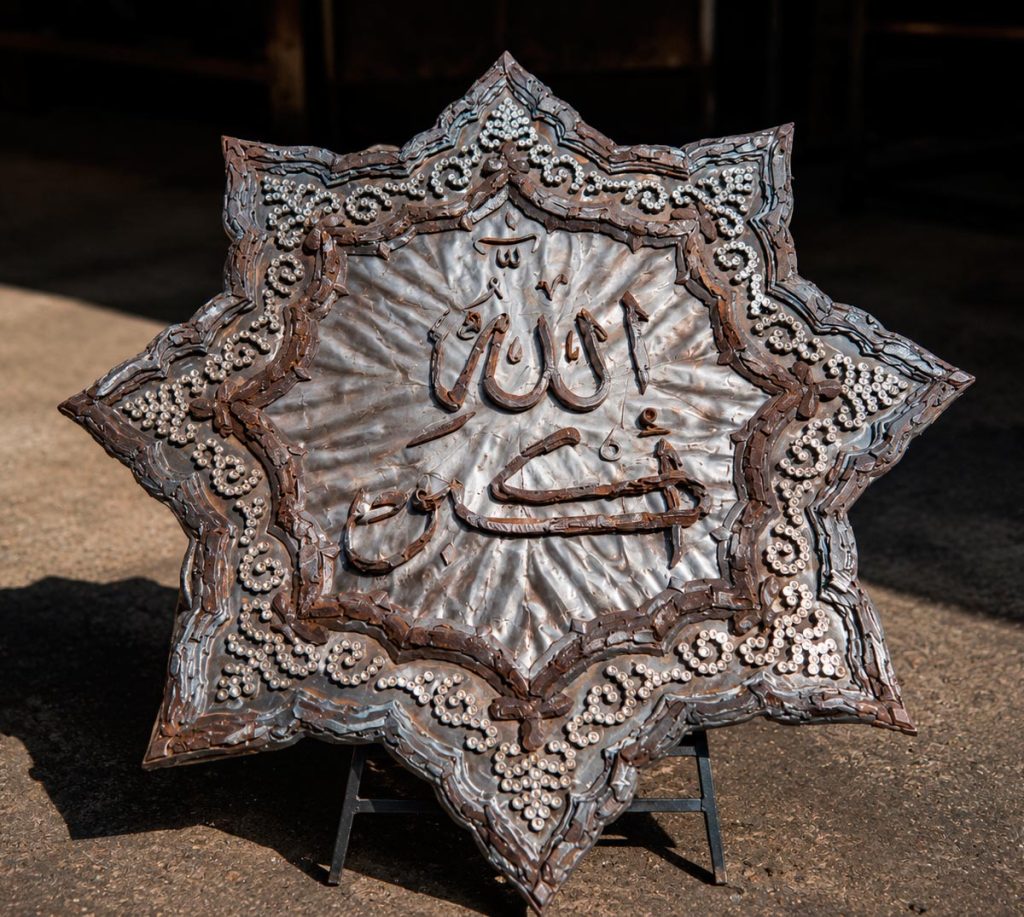
Allahu Akbar upon completion of 225 days of sculptural work, before the final galvanic treatment. The two decorative frames and the Arabic inscription “Allahu Akbar” (“God is Greatest”) will be finished in 999.9 fine gold, while the remainder of the work will be plated with nickel-, copper- and chromium-based alloys to achieve a distinctive green-toned metallic surface.
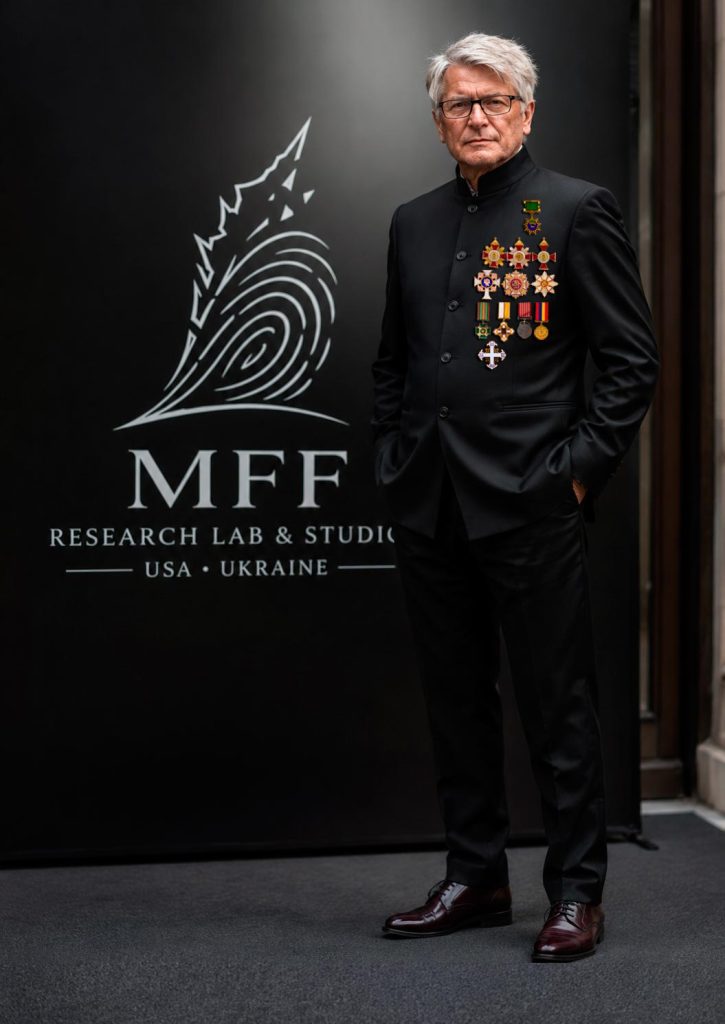
Sergey Melnikoff (MFF) in front of a promotional banner for his Odesa studio. The artist continues his work there under the constant threat of Russian drone and missile attacks.
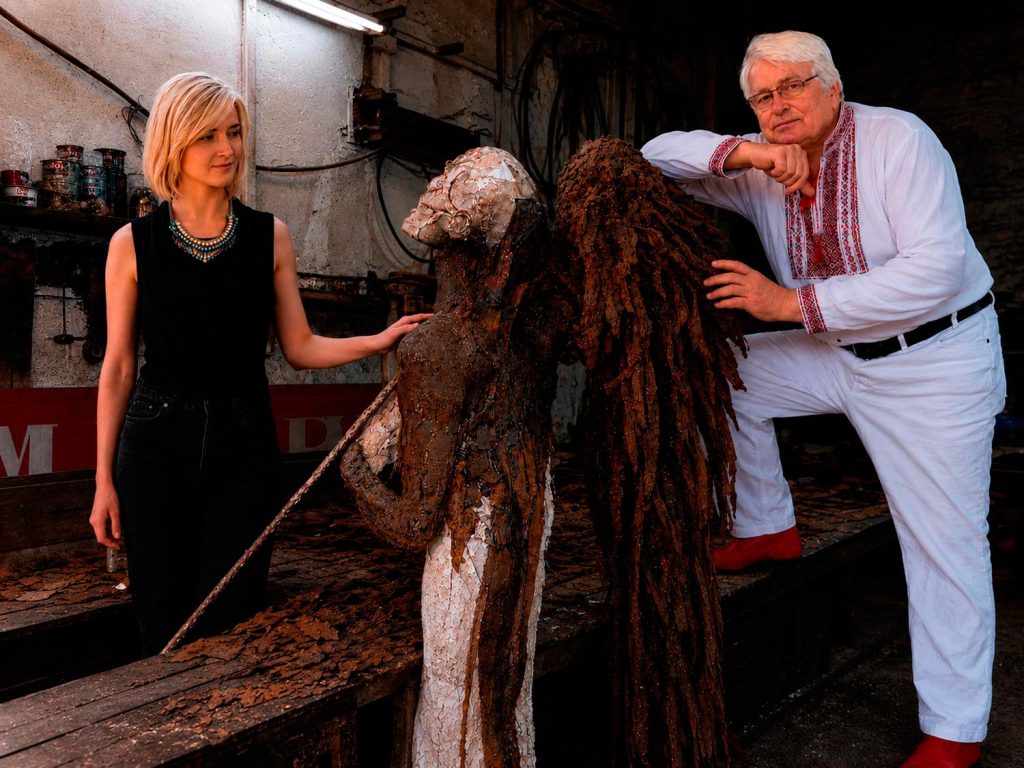
Sergey Melnikoff (MFF) and his daughter, Anastassia, at the artist’s Odesa studio, 2025.