


Ashes of War: A Technology Impossible Beyond Its Author
The experience of war, transmuted into the material of art, cannot be reproduced outside the artist’s personal presence within the space of that war
Why Ashes of War today remains accessible only to its creator — Sergey Melnikoff (MFF)
In the history of art, there are rare instances when a technique ceases to be merely a method and becomes inseparable from the personality of its creator. It is precisely to such phenomena that Ashes of War belongs, developed by the American artist of Ukrainian origin, Sergey Melnikoff (MFF).
This is not simply an authorial style or a set of technical procedures. It is a complete system of artistic thought, rooted in an extreme historical experience that cannot be transmitted, reproduced, or simulated.
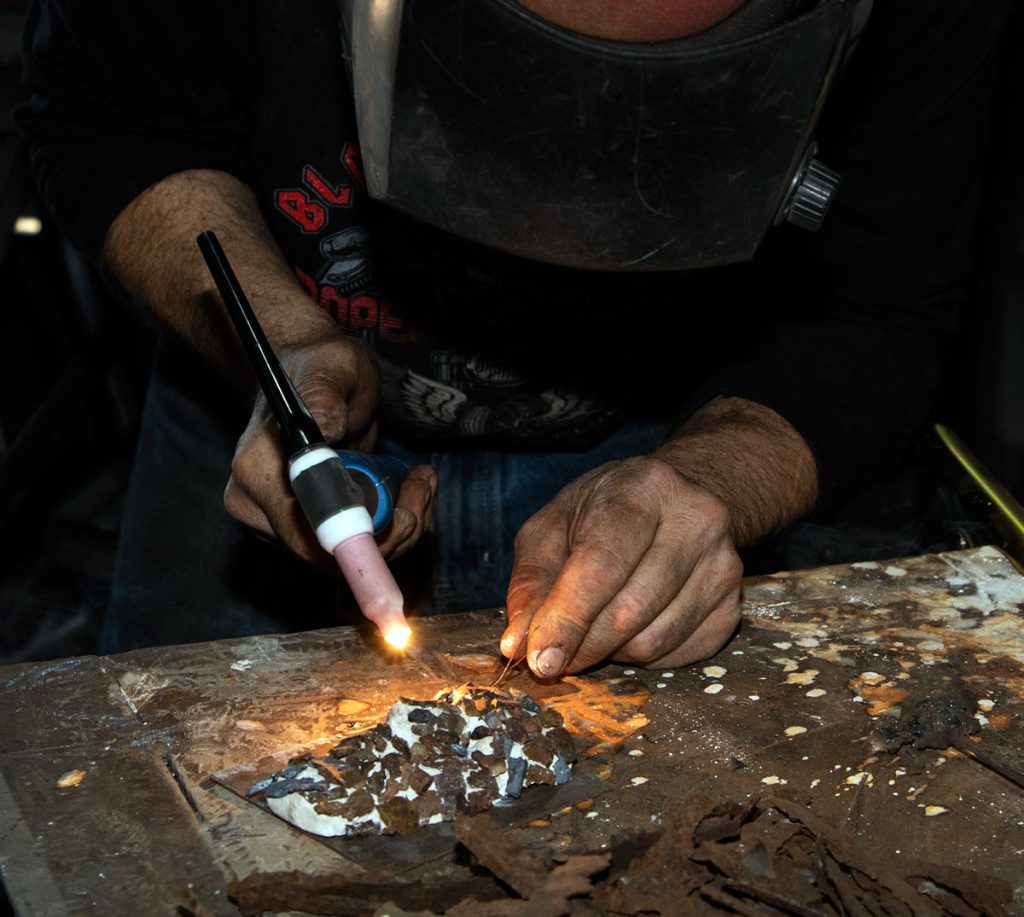
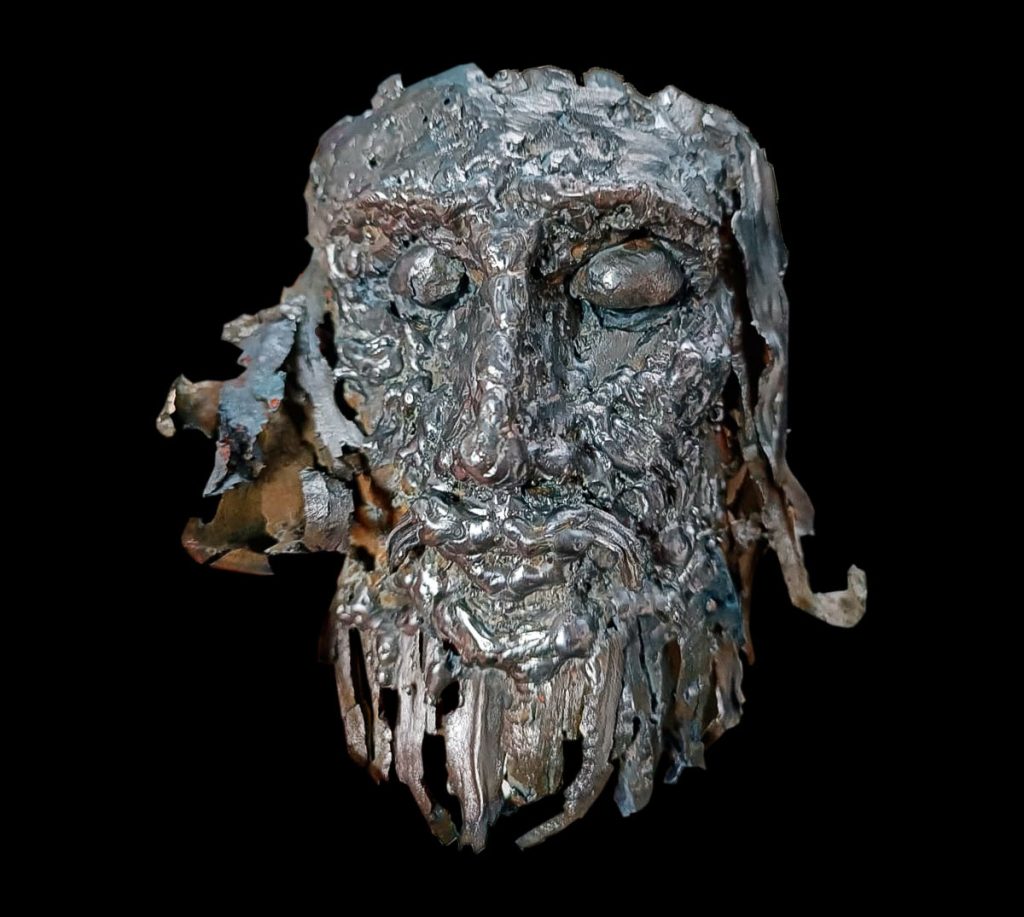
At the level of superficial perception, Ashes of War may be described as working with fragments of military ammunition — shards of artillery shells, mines, and destroyed structures. Yet such a definition is misleading. It reduces the phenomenon to the level of craft, whereas what we encounter here is an entirely new plastic language, in which the material does not submit to the artist but enters into an equal dialogue with him.
Each fragment is not raw material, but a witness. It carries within it the energy of explosion, the trace of destruction, a specific geography, and human tragedy. The artist does not arbitrarily transform it — he reads its form, submits to its inner logic, and incorporates it into the composition as an already existing, complete unit of meaning. Herein lies the radical distinction of Ashes of War from traditional sculpture: the act of creation becomes an act of recognition.
Yet the true uniqueness of this technology is revealed not only in the philosophy of form, but in the very process by which the material is obtained.
To create large-scale works — monumental crosses, figures, symbolic compositions — tonnes of fragments are required. Not metaphorically, but literally. These materials cannot be purchased or commissioned. The artist must collect them personally — travelling to zones of recent or ongoing combat, or to territories immediately after their liberation.
These are environments where the ground still conceals unexploded ordnance, where every step carries potential danger. The gathering of material takes place among debris that may contain remnants of explosives, in areas that are often not fully cleared. This is not an artistic expedition; it is a risk comparable to that faced by deminers.
The return journey is no less perilous — transporting metal along rural roads, often within reach of enemy drones. At any moment, the vehicle may be detected and attacked. Thus, even logistics becomes part of the artistic process, woven into its dramatic structure.
Equally significant is the context in which the works themselves are created. MFF’s studio is located in Odesa — a city that, for years, has been subjected to daily large-scale attacks by ballistic missiles and strike drones.
In the winter of 2025, one such strike landed directly within the vicinity of the studio. Its survival — and the preservation of the artist’s working space — was owed to a chain of circumstances bordering on the miraculous. Yet even after this, the process did not cease.
At this point, a crucial fact must be underscored: MFF is a citizen of the United States. He has every opportunity to live a safe and prosperous life, far from war — on the shores of the Caribbean, or anywhere else in the world where art exists within conditions of comfort and institutional support.
And yet, throughout all the years of war, he has consciously chosen to remain within this space — not episodically, not occasionally, but continuously, assuming the full weight of its risks and realities.
This choice carries Ashes of War beyond the conventional understanding of artistic practice. It transforms it not only into an act of personal testimony, but into an expression of genuine courage — the rare capacity to live and create deliberately within conditions of daily threat, without retreat, without distance, without translating tragedy into a safe metaphor. Here, aesthetics does not merely intersect with ethics — it is born from it, passing through the experience of fearless presence.
From an art-historical perspective, works created within this technology occupy a singular position. They stand at the intersection of several traditions:
— the culture of the reliquary, in which material possesses sacred significance;
— modernist and postmodern assemblage;
— and, simultaneously, the iconographic tradition, in which the image is formed not from form alone, but from meaning.
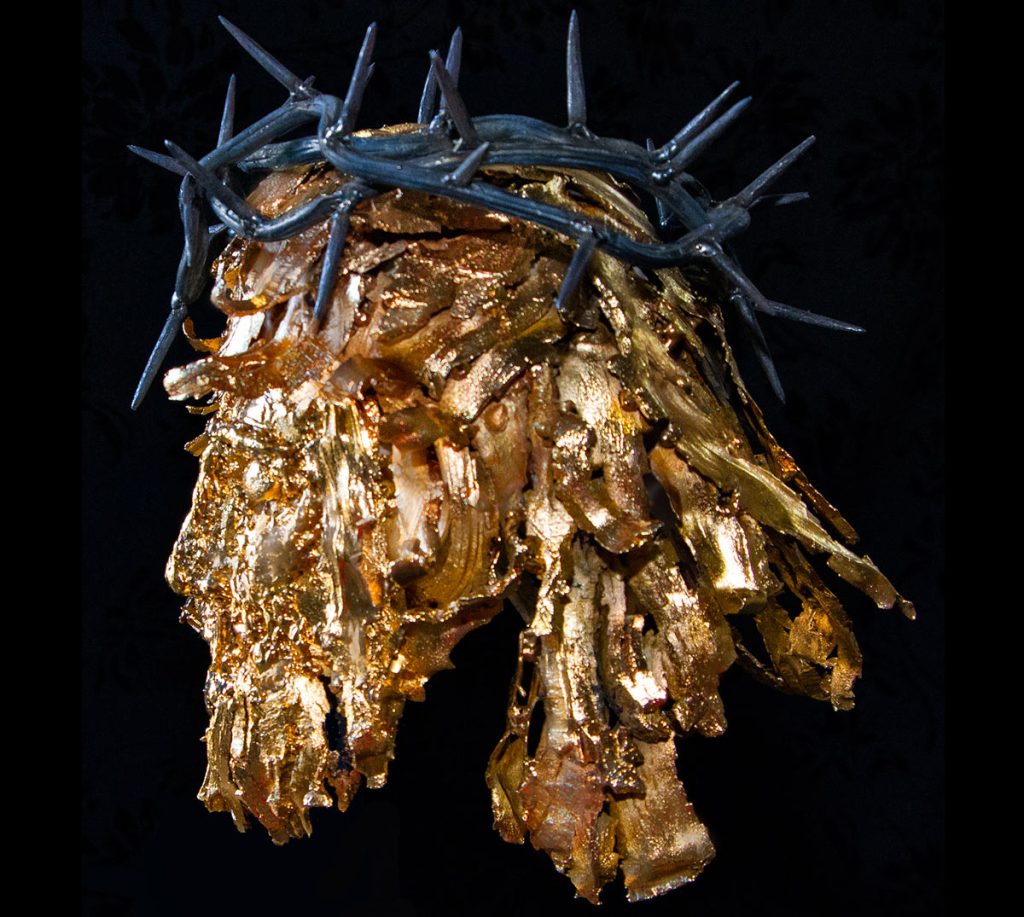
Particular attention must be given to The Holy Mandylion. In this work, the Ashes of War technology reaches an exceptional level of artistic concentration. The most complex handling of material — including the transformation of large-calibre ammunition fragments into a fabric-like structure — is combined with refined plasticity and near-jewelled precision of composition. A rare balance is achieved: the weight and aggression of the original material are entirely overcome, yielding to visual lightness, spiritual clarity, and an almost immaterial expressiveness of the image. This is a level of execution that places the work among the most outstanding achievements of contemporary sacred sculpture.
Yet no existing artistic paradigm is capable of fully describing what occurs here. In Ashes of War, the material does not symbolise destruction — it is destruction. And therein lies its radical force: the viewer encounters not an image of war, but its physical residue, transformed yet not stripped of its nature.
From this arises a particular tension that cannot be reproduced outside this context. Any attempt at imitation — the use of analogous forms, artificially created “fragments”, stylistic copying — is inevitably deprived of the essential element: the authenticity of origin and the experience through which the material has passed.
This is why Ashes of War today remains accessible only to its creator.
It is neither concealed nor protected — it is simply inseparable from the totality of his path: from the risks he has assumed; from the geography of war; from the inner decision to remain where history is being made; and from the ability to perceive in a fragment not an end, but the beginning of form.
In this sense, Ashes of War is not a technique.
It is a form of human presence within catastrophe, transformed into art.