Why Art Must Remember
The highest purpose of art is not to decorate memory.
It is to protect human dignity from oblivion.
There are moments in history when humanity discovers that memory alone is not enough.
Facts can be recorded.
Dates can be preserved.
Names can be engraved in stone.
Yet none of these, by themselves, can protect what is most fragile in human civilisation.
Human dignity.
Every war destroys lives.
The greatest wars attempt something even more devastating.
They seek to destroy the meaning of those lives.
They reduce human beings to numbers, cities to statistics, and suffering to political argument.
When this happens, memory itself begins to change.
It remembers events, yet slowly forgets the people who endured them.
This is the moment when art becomes indispensable.
Not because it decorates history.
Not because it offers consolation.
But because it refuses to allow human dignity to disappear beneath the weight of historical fact.
The artist cannot restore the dead.
Nor can art repair ruined cities or erase grief.
Its responsibility is different.
It preserves the humanity that violence tries to erase.
That responsibility belongs to every civilisation.
It belongs to every generation.
It belongs equally to those who create, to those who remember, and to those who are willing to look without turning away.
The works gathered in this volume were born during one of the darkest chapters of contemporary Europe.
They were not conceived as illustrations of war.
They emerged from a conviction that memory must remain inseparable from conscience.
For memory without conscience becomes an archive.
Conscience without memory becomes an illusion.
Art exists where the two meet.
Its highest purpose is not to decorate memory.
It is to protect human dignity from oblivion.
MFF Opens Its European Studio in Latvia
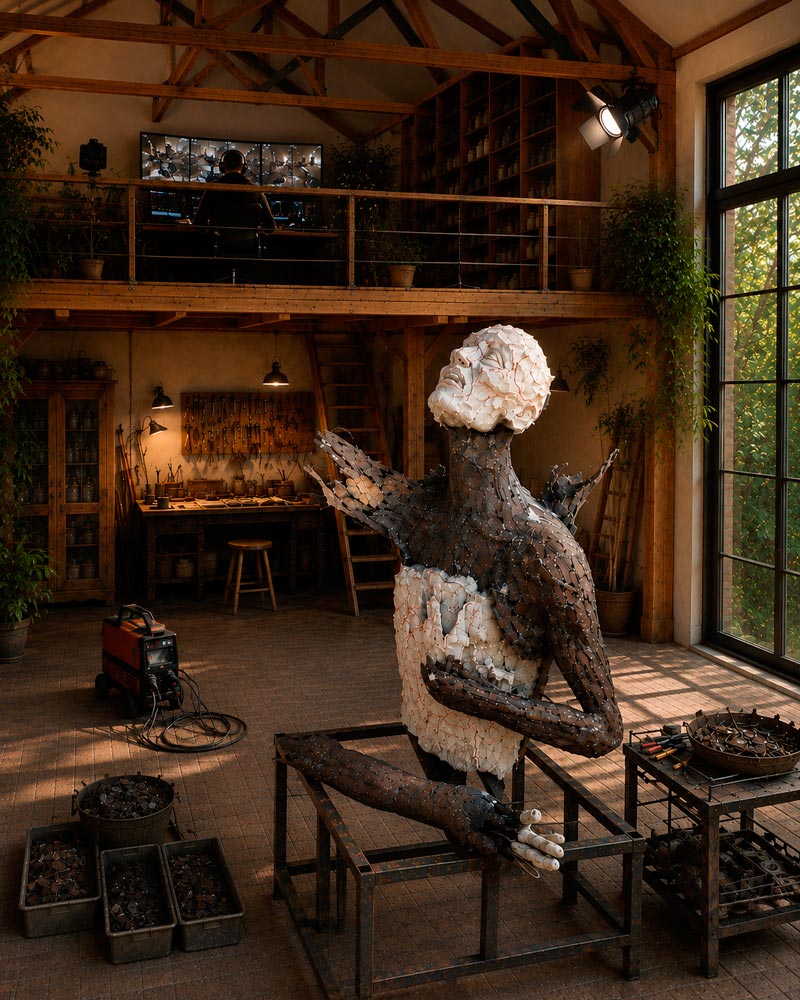
4 August 2026 | The European MFF Studio has been established in Latvia, where the next chapter of the Ashes of War project is now underway.